The “Everyday CTA” strategy that broke three LinkedIn rules (and quietly added $50,000 a week)

Why posting daily with a totally unrelated CTA quietly outperforms every “best practice” on LinkedIn.
Most LinkedIn advice tells you to do three things. We’re now sitting on close to two years of data that says all three are wrong.
I’ve been running an experiment on my own profile: post something valuable every single day, then bolt on a completely unrelated call to action with a clickable link sitting right there in the body of the post.
No clever bridging. No moving the link to the comments. No worrying about whether the audience is sick of it.
And here’s what matters: it’s not a hack. It’s a tone. When you separate value from CTA, you remove the “this was an ad all along” feeling — and people engage more freely.
Below: the strategy, the rules it breaks, and how to run your own version this week (without turning your LinkedIn into a billboard). Plus this strategy utilises the power of ScoreApp and how this Everyday CTA is a marketing campaign in it’s own right.
The Everyday CTA in one paragraph
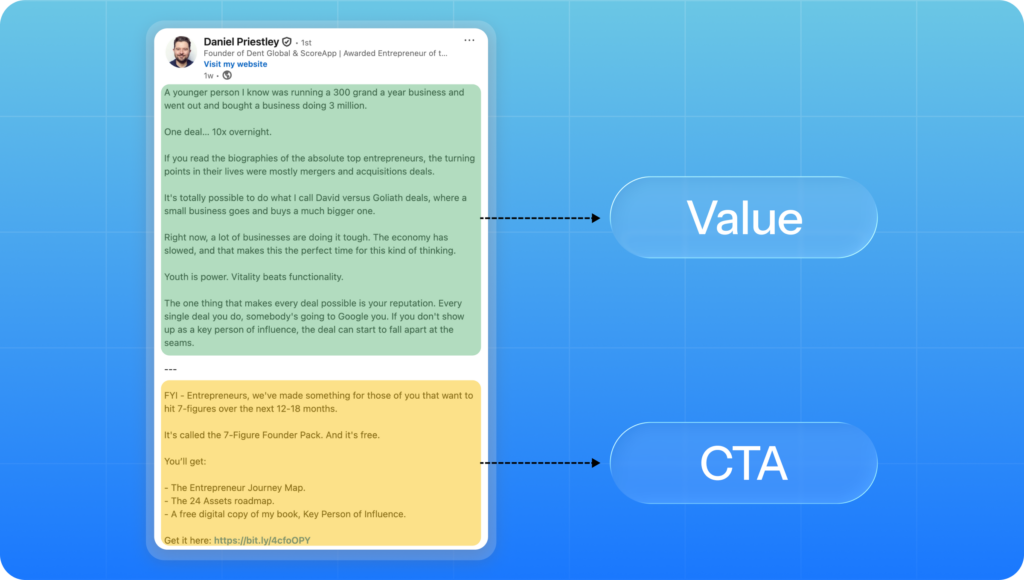
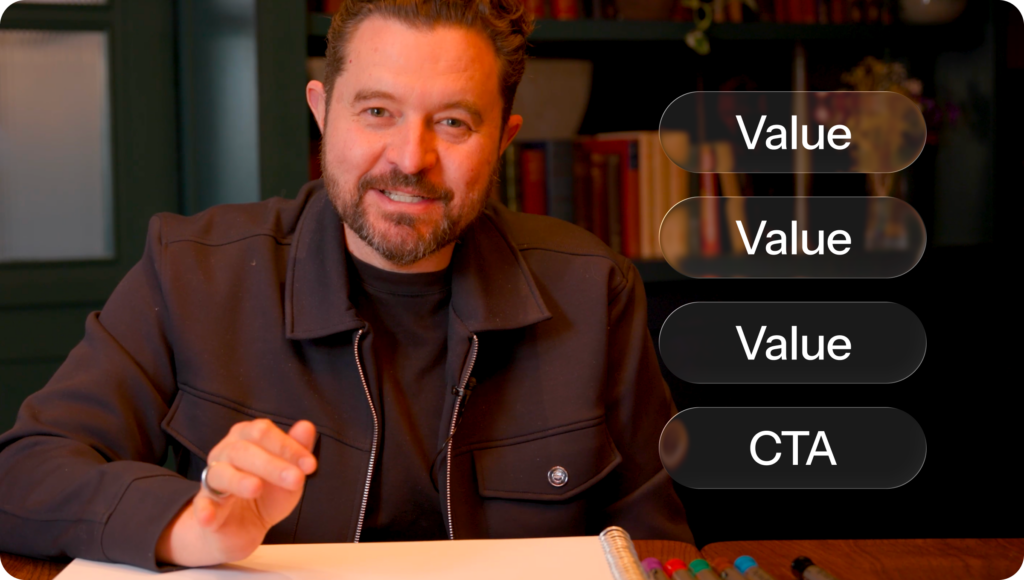
Every post is two parts. Part one is value – something genuinely useful. Part two is a CTA, completely unrelated to part one, with the link in the body of the post. You do this every day. You rotate your CTAs. You let people choose to engage or not.
That’s it. The whole strategy fits on a Post-it.
Part one: how to make sure people actually read it
My framework for picking what to share is the 3 S’s and 2 F’s – five filters for whether something is worth posting:
- Scary – a trend, technology, or piece of news that’s about to disrupt your audience’s industry.
- Strange – something quirky, unfamiliar, or said in a way no one’s saying it.
- Sexy – a desirable outcome. The result everyone in your space secretly wants.
- Familiar – something or someone your audience already knows. (“Three lessons from Warren Buffett on…”)
- Free value – something that looks like it should cost money. Research, a teardown, a framework you’d usually charge for.
If a post idea doesn’t pass at least one of these filters, it isn’t ready.
Format-wise: 100–500 words of text, a carousel, a visualized stat, a diagram, or video. Especially video. LinkedIn has quietly become one of the best places to post both short and long-form video right now. I’ve seen LinkedIn videos outperform the same content on YouTube, partly because people don’t mind being seen scrolling LinkedIn at work.
Part two: the call to action that breaks every rule
Here’s where most experts will disagree with you.
Rule one they say to follow: “Your CTA must be tightly linked to your post content.” I found the opposite is true. You can be talking about literally anything – supply chains, parenting, an interesting podcast – and then say, “By the way, I’m running a workshop on Tuesday. Link below.” It works.
Rule two they say to follow: “Never put links in the body of a post – LinkedIn will throttle reach.” We’ve A/B tested this for the better part of two years across hundreds of posts. Links in the body get the same reach, the same engagement, and the same comments as posts without them. The “link in comments” hack is solving a problem that doesn’t exist.
Rule three they say to follow: “If you promote every day, your audience will get annoyed.” In two years of doing this seven days a week, I haven’t received a single complaint. No DMs. No friends quietly suggesting I tone it down. Nothing.
Why? Because the value and the CTA are separated. You’re sharing something useful, then mentioning – almost as an aside – something else that exists if they want it. There’s no needy energy. No gear-grinding pivot from value to pitch. Just “oh, by the way.”
What to actually use as your CTA
I rotate between four:
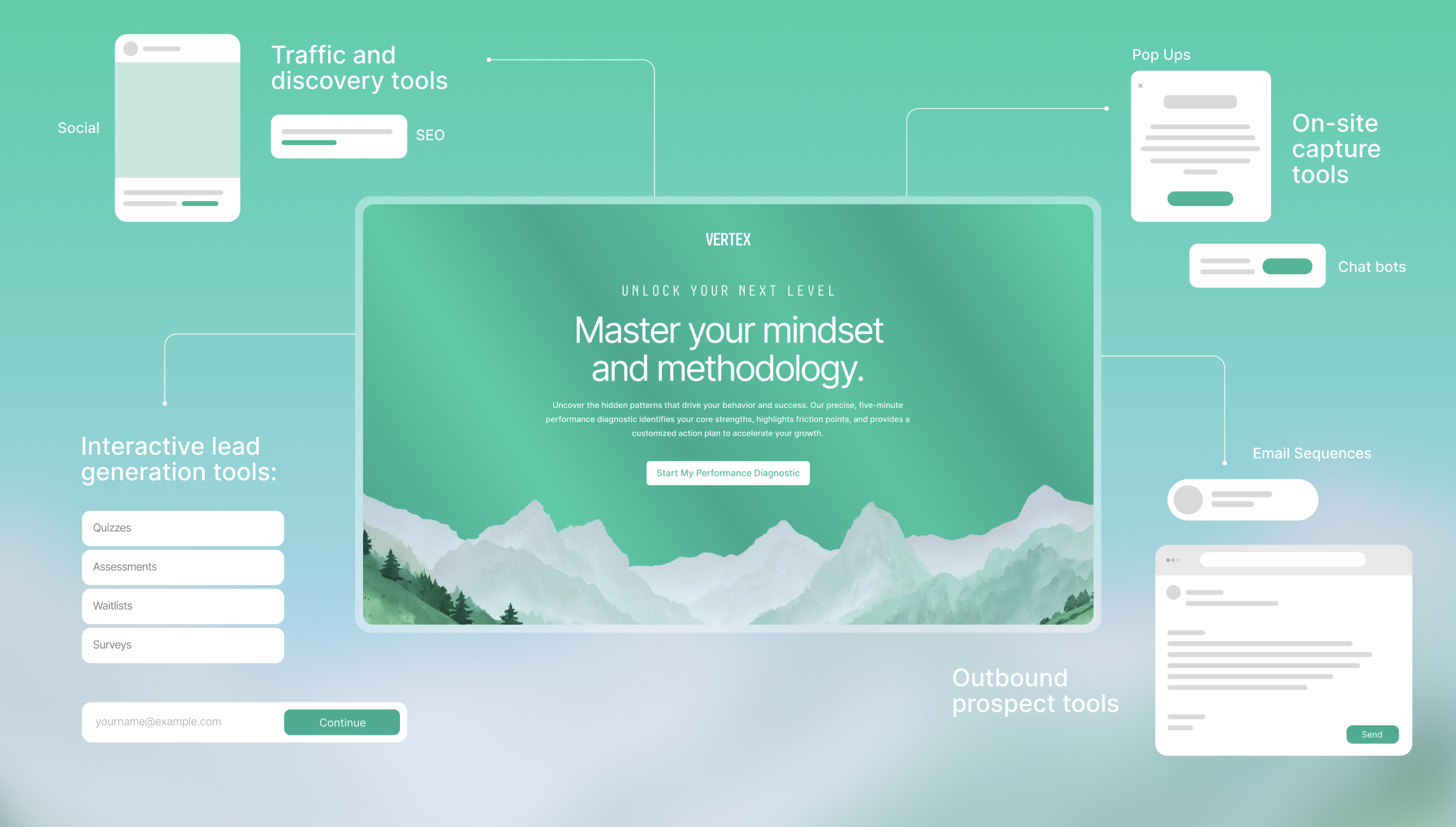
- An interactive assessment (e.g., “Take this 4-minute scorecard to see if you’re a Key Person of Influence in your industry.”)
- A waitlist for an upcoming product or program
- A live workshop or webinar
- A mini course or downloadable resource
All four are scorecard types you can build inside ScoreApp. So if you’re a coach, agency, or service business already using ScoreApp, you’ve got everything you need to power this on day one. Set up two or three CTAs, rotate them on different days of the week, and let the strategy run.
The “with or without you” energy
The reason this works isn’t tactical. It’s tonal.
I call it “with or without you” energy. The CTA is happening regardless. You can click or not. Doesn’t matter. “By the way, here’s the link if you want it.”
When you try to thread the needle between value and CTA, the post starts to feel like an ad with extra steps. Audiences smell it instantly. When the two are completely separate, your value content stays valuable and your CTA stays optional.
Counterintuitively, more people click.
The piece most people get wrong
The strategy works if the place you’re sending people is built to convert. A great LinkedIn post in front of a mediocre landing page just leaks attention.
This is why I like sending people to a scorecard.
A scorecard isn’t a “download and disappear” experience. It’s interactive. People answer questions, get a personalized result, and feel understood. That creates higher engagement — and warmer leads.
If you’re using ScoreApp, this is the sweet spot. When these funnels are set up well, they often convert strongly because the value isn’t promised later. It’s delivered during the experience.
Every assessment landing page needs four things:
- A hook – why should I care?
- A value proposition – what do I get?
- Credibility – why should I trust this?
- A clear, single call to action – what do I click?
If your scorecard’s intro page has those four things, the LinkedIn-to-assessment handoff feels seamless. If it doesn’t, fix that before you scale the daily posting.
What to do this week
Pick one CTA destination. (For most people, this is an existing scorecard.)
Plan five days of value content using the 3 S’s and 2 F’s filter.
Write the post. Add “By the way…” and the CTA at the bottom. Drop the link straight in.
Post it. Don’t move the link. Don’t apologize. Don’t link the value to the CTA.
Repeat tomorrow.
That’s the whole strategy. It compounds because you’re consistent, your CTA stays optional, and your destination is built to convert.
A quick note on results (context, not the point)
In my case, this approach has produced standout outcomes — including weeks worth five figures in attributable new business when paired with an interactive assessment.
But the real takeaway isn’t the number.
It’s the mechanism: daily value + optional CTA + a destination that converts.
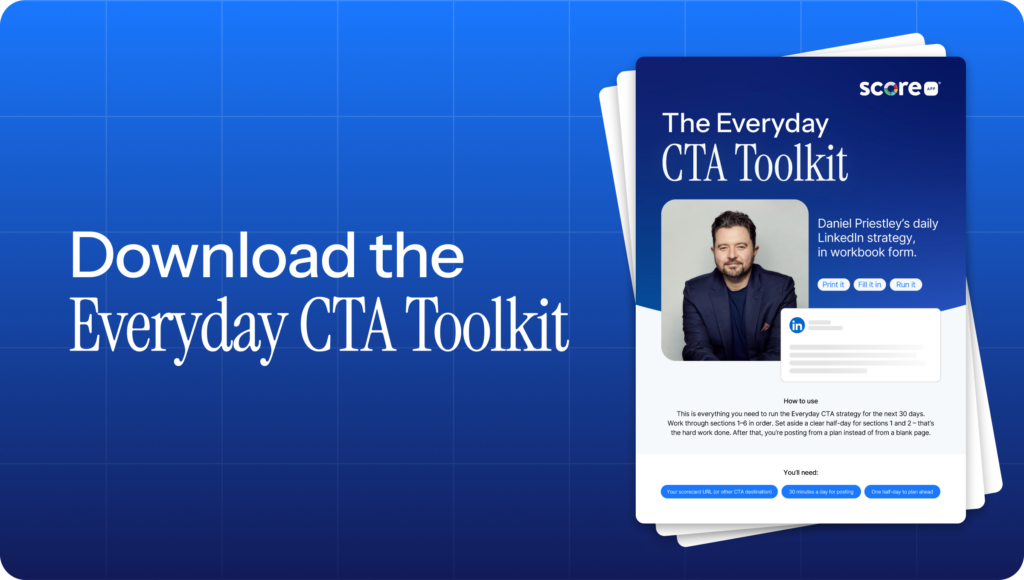
Grab the free Everyday CTA toolkit (PDF)
We’ve put together a free workbook to help you actually run this: a 30-day content planner, a “by the way” CTA swipe file, a LinkedIn post template, and the four-point landing page check.