How Thea Brook lifted her close rate from 30% to 80%

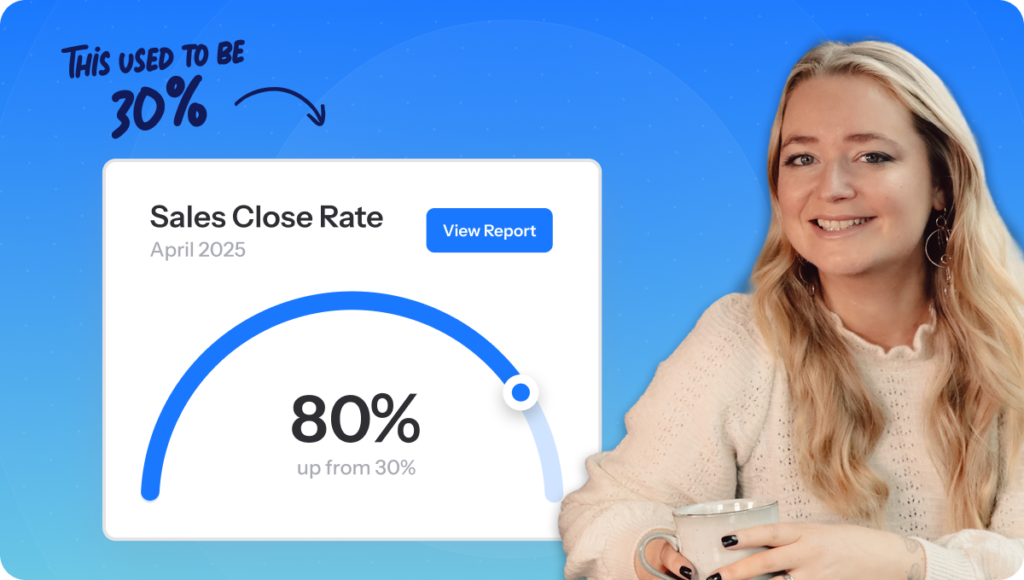
“My close rate probably went from somewhere around 30%, up to more like 80%.” — Thea Brook, former CFO, founder of CALMM
TL;DR
Thea Brook is a former CFO and the creator of CALMM – a business operating system for founders scaling to seven figures without the burnout. She had a strong LinkedIn audience but no reliable way to turn followers into clients, and she was over-reliant on in-person events to fill her pipeline. She built a ScoreApp scorecard. Within the first week she signed a complete “internet stranger” as a client. Inside a year, she’d added over £100,000 in revenue, lifted her sales close rate from around 30% to roughly 80%, and at one point had to pause her scorecard because the lead volume was outpacing her capacity to deliver.
At a glance:
- Business: CALMM – a business operating system for seven-figure founders
- Founder: Thea Brook, former CFO and multi-time founder
- Tool: ScoreApp lead qualification scorecard
- Headline result: Close rate 30% → 80%
- Revenue impact: £100k+ added
- Time to first new client from a cold lead: 1 week
The problem: a strong audience, no bridge to revenue
Most coaches and consultants don’t have a content problem. They have a qualification problem.
Thea had spent serious time building a presence on LinkedIn. She had an engaged audience, plenty of attention, and the kind of credibility that comes from having actually been a CFO before becoming a founder. What she didn’t have was a way to take someone from “I follow Thea on LinkedIn” to “I’m ready to invest with Thea.”
The bridge she’d been using was in-person events. It worked, but it didn’t scale. Her own words sum it up neatly:
“The people I ended up working with were people I’d maybe met in person quite a few times, or we’d ended up connecting through a friend or an event… which is fine to begin with, but it’s just not very scalable.”
Once she had a few clients and was actually delivering the work, the time she had for events evaporated. The pipeline went with it. She had no lever she could pull to generate qualified leads on demand.
If you’ve ever felt that your marketing is a feast-or-famine cycle that depends entirely on you being in the room, this is the same problem.
What was actually broken
It wasn’t reach. It wasn’t the offer. It was the middle of the funnel – the gap between someone discovering Thea and someone trusting her enough to book a sales call.
Three things were quietly costing her money:
- Trust was being built too slowly. LinkedIn could put her in front of people, but it couldn’t move them through a structured experience that helped them see how she could help them specifically.
- There was no segmentation. Every lead got the same generic next step, regardless of where they actually were in their business.
- Discovery calls were doing all the work. People were turning up to calls cold, with no clear sense of their own situation or what they needed. Thea was effectively diagnosing and selling at the same time, which is exhausting and converts poorly.
This is the textbook scenario ScoreApp was built for.
The fix: a scorecard that does the warming up for you
Thea built a ScoreApp scorecard – an interactive assessment that gave her audience a useful, personalized experience while quietly doing the qualification work in the background.
Instead of a generic “book a call” CTA on her LinkedIn posts, people landed on a scorecard that asked them about their business, scored their answers, and gave them a tailored result based on what they actually needed. ScoreApp segmented the audience automatically based on their real challenges, so by the time they reached Thea, she already knew:
- Whether they were a fit
- What stage of the journey they were at
- Where the friction was in their business
- What the most useful next step looked like for them
That last point is the one that flipped her business.
“The calls I was getting on, people were really ready to make a buying decision.”
People didn’t arrive at the call asking “what do you do?” They arrived having already diagnosed their own situation, with language for it, and with an opinion about whether Thea was the right person to help. The scorecard had done the heavy lifting before she ever got on Zoom.
This is the difference between a form tool and a lead qualification scorecard. Form tools collect inputs. ScoreApp turns inputs into interpretation and personalized next steps.
The results
Thea went live with her scorecard in December. Inside a week, she signed a new client – someone she’d never met, never spoken to, who had found her on LinkedIn, gone through the scorecard, and decided to work with her on the strength of that experience alone.
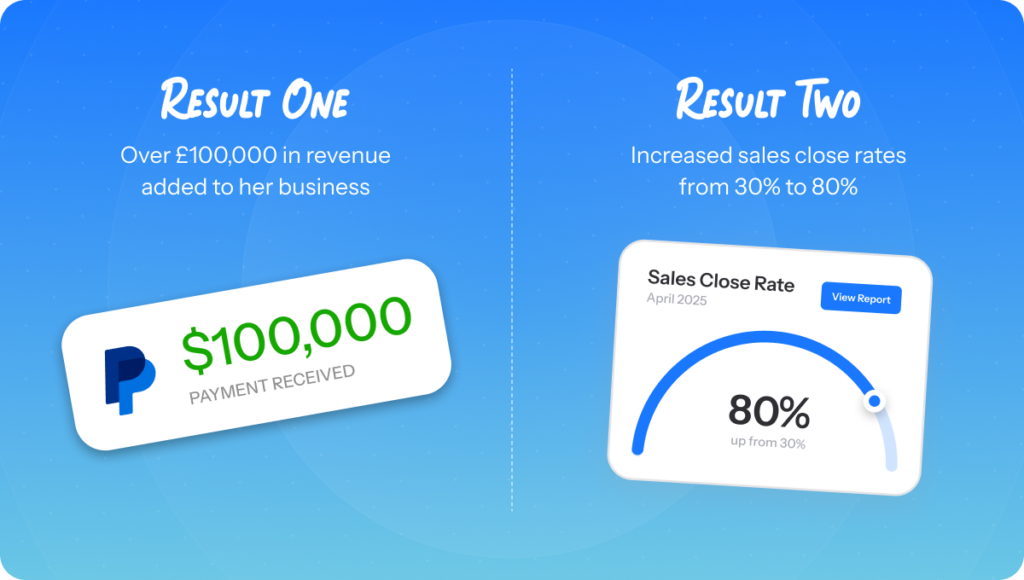
A year on, the picture looked like this:
- £100,000+ in additional revenue, attributable to leads that came through the scorecard.
- Sales close rate up from around 30% to roughly 80%. Same Thea, same offer – different leads at the point of the call.
- A new lever in the business. Marketing stopped feeling like guesswork, and more importantly, stopped depending on Thea showing up at events.
- Repositioned authority. Thea felt confident enough to choose her clients, rather than the other way around.
- A “good problem” pause. At one point she had to pause the scorecard, because the volume of qualified leads was bigger than her delivery capacity.
That last point matters. The thing that breaks most consulting businesses isn’t bad leads – it’s unpredictable leads. Thea built something predictable enough that she could turn it on and off.
What this means for you
If you’re a coach, consultant, or founder-led services business and any of this sounds familiar, the lesson here isn’t “Thea is brilliant” (although she is). The lesson is structural.
Your sales calls are doing too much work. If your close rate is sitting in the 20–30% range, the issue probably isn’t your sales skill. It’s that you’re trying to qualify, educate, diagnose, and close in the same 45-minute window. A scorecard moves three of those four jobs upstream.
Your audience needs a middle step. “Follow me on LinkedIn” and “book a sales call” are two very different levels of commitment. Most of your audience isn’t ready for the second one. A scorecard gives them a useful, low-friction way to move forward without forcing the sales conversation.
Personalization beats volume. Thea’s scorecard didn’t add 10x more traffic to her business. It added clarity. The leads were better, the calls were warmer, and the conversion went up. None of that requires more reach.
Owned demand beats borrowed demand. Events and LinkedIn are borrowed channels. A scorecard plus an email list is something you own – which means you can pull that lever again next quarter.
How to do this in your own business
Here’s the practical version. You don’t need to build this from scratch.
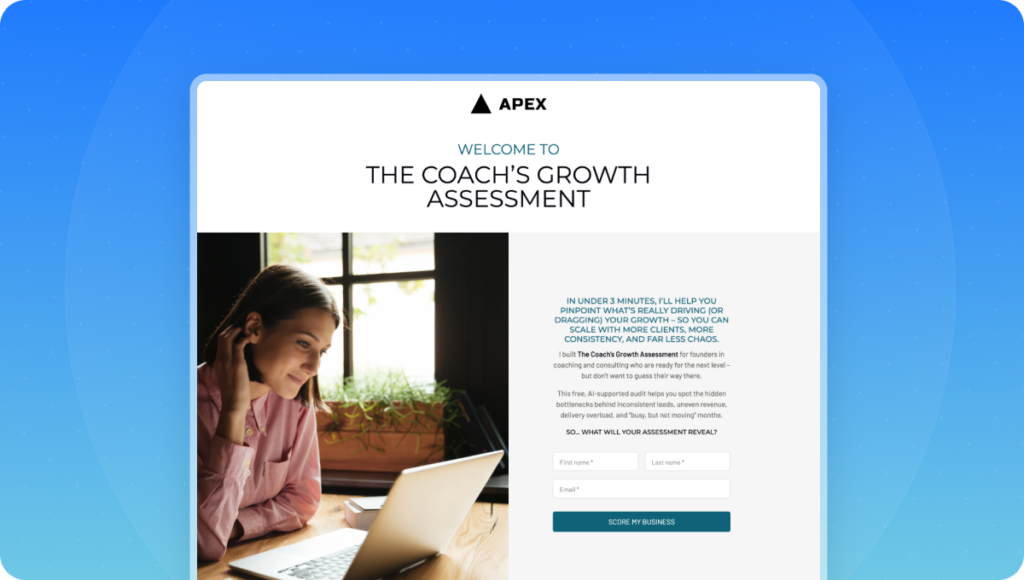
1. Steal Thea’s template as your starting point. We’ve made Thea’s scorecard available as a ready-to-clone ScoreApp template – the Coach Growth Assessment. Clone it, swap in your business, your questions, and your scoring logic, and you can have a version live in your own brand in a single working session. 👉 Clone the Coach Growth Assessment template
2. Get clear on the question your scorecard answers. The best-performing scorecards answer a specific question your prospect is already asking themselves. For Thea, it was a diagnostic on where founders are getting stuck on the path to seven figures. For you, it could be “How fundable is your business?”, “How ready are you to scale your team?”, “How profitable is your service offer?” – something your audience can’t easily answer alone.
3. Build the scoring and segmentation around your real client types. Don’t try to score on cleverness. Score on the things that actually predict whether someone is a fit. Are they at the right stage? Do they have the right problem? Do they have the budget and the readiness to act?
4. Connect the result to a personalized next step. This is the bit most people miss. The scorecard isn’t the end of the journey – it’s the bridge. Each segment should land on a tailored result page with a tailored next step (book a call, watch a video, download a resource, join a waitlist). Same scorecard, different paths.
5. Promote it everywhere you used to promote a “book a call” link. LinkedIn posts, podcast bios, email signatures, speaking gigs, lead magnets. Everywhere you currently send people to a calendar, send them to the scorecard instead.
6. Watch the data and refine. ScoreApp gives you the answers people gave, the segments they fell into, and where they dropped off. Use that to sharpen your messaging, refine your offers, and – like Thea – package your services around what your audience is actually telling you.
Thea’s own words
We’ll let her close this one out:
“ScoreApp has genuinely had a huge impact on my business, and I know it will for you as well. So give it a try.”
Try it for yourself
Thea’s scorecard is one of thousands now running on ScoreApp – built by coaches, consultants, agencies, and founder-led service businesses to qualify leads, reveal who’s ready, and personalize the next step.
If you’re sitting on a strong audience that isn’t converting like it should, the issue probably isn’t your audience. It’s the bridge.
Two simple next steps:
- Clone the Coach Growth Assessment template and customize it for your business → scoreapp.com/templates/coach-growth-assessment
- Or start your own from scratch → Create your scorecard today
Stop chasing leads. Start choosing them.