How One Agency Owner Went from 5-Figures to 7-Figures by Qualifying Leads Differently


Most agency owners assume that to grow, they need more leads. As a result, they try to drive more traffic, generate more enquiries, and book more calls.
Martin Huntbach thought the same. For a while, that approach kept things ticking over and helped him win new clients. However, because the strategy was simply ‘more traffic = more clients’, he did not always win the right clients. That led to more stressful relationships, unpredictable revenue, and a team that dreaded certain names appearing in their inbox. In Martin’s case it was mo’ leads, mo’ problems.
The shift that changed everything did not come from a bigger ad budget or a new lead generation channel. Instead, Martin implemented a qualification system – a structured, repeatable process that identified his ‘perfect-fit clients’ before the first call, filtered out the wrong ones automatically, and turned the right conversations into long-term retainers at an 80% conversion rate.
That system took Martin’s agency from five figures to six figures to seven. Better still, he has put the entire formula into a free blueprint so other agencies can replicate it.
🎥 Watch first: the 2-minute overview
Before we walk through the system in detail, Martin breaks down the core idea in under 2 minutes. So, if you’re short on time, start here – then come back to the full breakdown below.
Want the full system to find your perfect-fit clients? Sign up to access the free blueprint here.
The problem with how most agencies win clients
Running an agency or service business is hard enough when your clients are a great fit. When they are not, the whole business can feel completely different.
You probably know the type of client already. They send emails over the weekend. They want first-page Google rankings without the budget to support it. They always feel like more work than they are worth. Most agency owners have worked with clients like this, and they know the effect those relationships have on the team.
However, here’s the thing: most of those clients showed warning signs before the relationship even started. The problem was not a lack of signals. The problem was a lack of system to spot them early enough.
Without a qualification process, agencies tend to treat every enquiry in roughly the same way. You jump on a call, learn about the business, write a proposal, and hope for the best. Sometimes that works and you land a fantastic client. Many times, though, it does not. Either you waste time on discovery calls with prospects who could never really afford your service, or you reshape your offer because you feel pressure to close the deal.
Martin changed that at the source. Rather than improving the proposal or trying to get better at sales alone, he built a system that meant he only had serious conversations with people who already looked like a strong fit. That is the exact method Martin covers in his full blueprint, and you can replicate it for your own agency or service business.
Step 1: Define what a perfect-fit client actually looks like TO YOU
The first step in Martin’s system has nothing to do with technology or funnels. Instead, it starts with a simple exercise: look back at every client you’ve worked with and rate them out of ten.
Your nines and tens are your template. These are the clients you would clone in a heartbeat. They are the ones your team lights up for. They stayed, paid well, and became the kind of relationships that made the work worthwhile.
Your ones and twos matter just as much. They do not show you who to chase. Instead, they show you the warning signs you need to screen for early.
The three traits that matter most
Three things usually define client quality across the board:
- Profit – Not every high-turnover client is a good-margin client. So, if you want more of the right business, start by identifying your most profitable relationships.
- Enjoyment – Does your team feel energised by this client? Do they bring creativity and care to the work, or do they dread the next email?
- Longevity – Are they committed to the relationship? Do they see you as a long-term partner, or are they still shopping around for the lowest price?
Once you identify two or three clear examples of your ideal client, you create the foundation for everything that follows.
Step 2: Ask the questions that predict whether a client will succeed WITH YOU
Most agency enquiry forms ask for a name, a company, and maybe a short description of what the prospect wants. That is not qualification – it is just data collection.
Martin’s system works differently. It asks questions designed to reveal whether a prospect actually matches the profile of a great client. In fact, your best and worst past clients will usually tell you exactly which answers you should look for.
The questions that uncover fit early
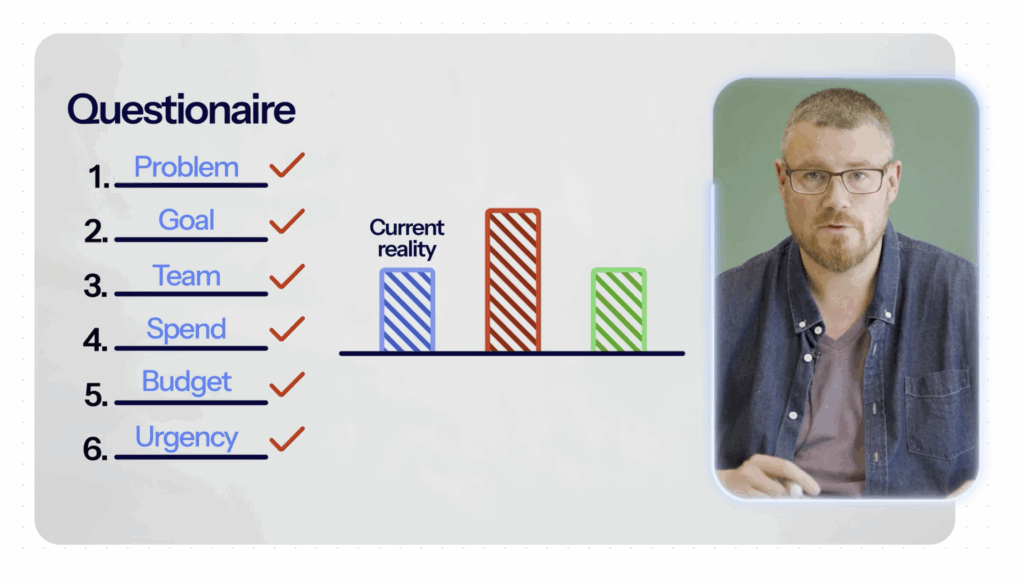
The areas that tend to matter most are:
- Problems – What are they struggling with right now? Your best past clients usually described their problems in a clear, specific way. By contrast, your worst clients were often vague or focused on things you could not realistically solve.
- Goals – What does success look like in six or twelve months? Realistic, specific goals are a strong signal. On the other hand, unrealistic expectations – or goals that do not match what you actually deliver – should raise concerns early.
- Current spend – What are they already investing in marketing or agency support? This tells you how seriously they take the function and whether your pricing even sits in the same ballpark.
- Budget – What would they be willing to invest with a new agency? Asking this directly removes a huge amount of wasted time on both sides.
- Team and company size – Who will you actually be working with day-to-day? More stakeholders usually mean more complexity, so you need to reflect that in both resourcing and pricing.
- Urgency – How ready are they to move? Someone who needs to start tomorrow and has no time for proper discovery can create just as many problems as someone who is never going to commit.
The more information you collect before the first call, the better. As a result, you can have a more focused, productive conversation and decide in advance whether it is even worth having.
Step 3: Use a traffic light scoring system to prioritise YOUR pipeline
Collecting qualification data only helps if you act on it consistently. Martin solves that by using a simple traffic light scoring model – Red, Amber, and Green – that determines exactly how much time each prospect gets.
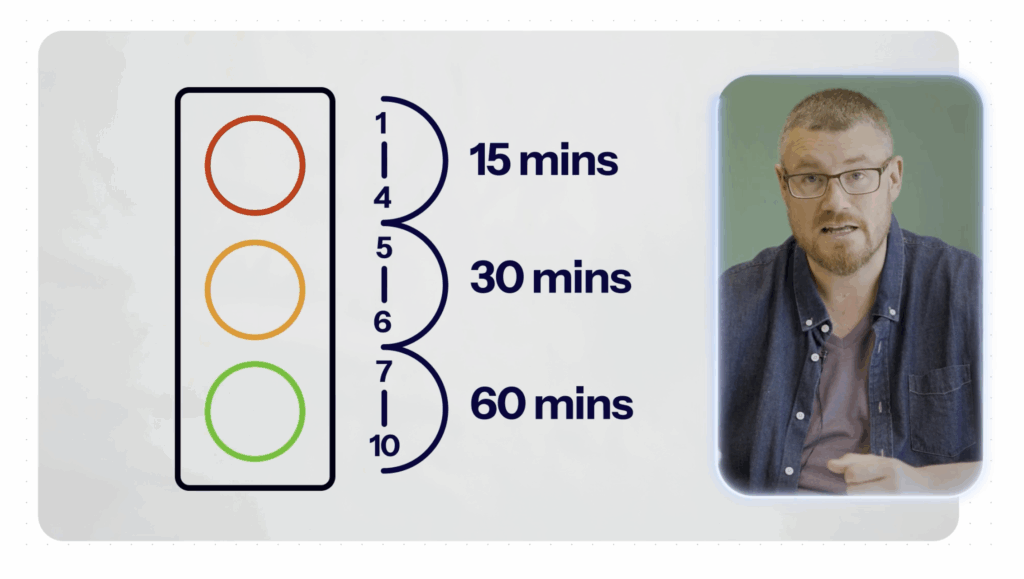
- Red (low fit): Give them a short 15-minute call. That gives you enough time to check your instincts, rule them out, or spot signs you may have scored them incorrectly.
- Amber (possible fit): Give them a 30-minute conversation to explore the areas of uncertainty. These prospects show promise, but you still need to dig into a few unknowns.
- Green (perfect fit): Give them a full 60-minute session. Treat that time as the start of a long-term relationship.
This one change transforms how you spend your time. Instead of giving every inbound lead the same diary slot regardless of fit, you direct your energy toward the conversations most likely to lead somewhere meaningful.
Inside ScoreApp, the whole process runs automatically. Prospects complete their scorecard, ScoreApp scores them against your criteria, and then the platform routes them to the right booking link automatically. So, by the time a call lands in the diary, you already know who you’re speaking to and what kind of conversation to expect.
Step 4: Use the call to CLOSE, not to start from scratch
Most first sales calls focus on gathering basic information about the prospect’s business. Martin changed that. Because the scorecard collects that information before anyone picks up the phone, the first call can do a much better job.
Instead of using the call for discovery, Martin uses it for depth. He explores the answers the prospect already gave, understands the context behind them, and builds a clearer picture of the right path forward. In many cases, that means the call moves much closer to a sale.
Just as importantly, walking through their answers shows the prospect that you paid attention and came prepared. In other words, this is not a generic sales call. It is already a conversation about them.
What strong prospects usually do
Strong prospects usually lean in. They answer questions openly. They discuss their problems honestly. They engage in a proper conversation about their business.
Weak prospects often do the opposite. They resist the questions, jump straight to price, or refuse to engage properly. That, in itself, is useful information. In Martin’s experience, the prospects who become great long-term clients are almost always the ones who engage openly from the start.
Step 5: The paid strategy session that CONVERTS at 80%
This is the step most agencies skip. However, it is also the step that makes the biggest difference to Martin’s conversion rate.
Rather than moving straight from discovery call to retainer proposal, Martin introduces a paid strategy session first. At £5,000, it becomes a focused four-week engagement where his team builds a complete picture of the client’s business before recommending a package.
At first glance, that might sound like it slows things down. In practice, though, it does the opposite.
Why the strategy session works so well
- It filters out anyone who isn’t serious. If a prospect will not invest in a strategy session before a retainer, they are telling you something important about how they value the work.
- It protects both sides. You do not recommend a package before you fully understand what the client actually needs. Equally, the client does not commit to an ongoing relationship before they see how you think and operate.
- It builds real trust. Martin presents a clear, honest plan that he would recommend whether or not the client works with his agency. Therefore, by the time the retainer conversation happens, the client already knows the quality of his thinking and trusts it.
- It adds revenue upfront. The strategy session is not a cost of sale. Instead, it is a paid engagement in its own right. The discovery work gets done, and the agency gets paid for the expertise it applies.
The result is powerful: around 80% of clients who go through the strategy session go on to sign a retainer. Not because Martin pushes harder, but because the relationship already exists, the value has already been demonstrated, and the next step feels obvious.
Compare that to the industry average of 10 to 20% on cold sales calls, and the difference speaks for itself.
How ScoreApp runs the whole system automatically
Martin has used ScoreApp to power this qualification system for the past three to four years. The reason it works at scale is simple: once it is set up, almost none of it requires manual effort.
Here’s what the process looks like in practice:
- A prospect lands on Martin’s ScoreApp scorecard and works through the qualification questions at their own pace.
- Their answers are scored automatically. Then ScoreApp segments them as Red, Amber, or Green based on the criteria Martin has set.
- Each segment is routed to a personalised results page and the right booking link – 15, 30, or 60 minutes – without anyone on Martin’s team having to lift a finger.
- Before each call, Martin reviews the prospect’s answers in his ScoreApp dashboard. As a result, he arrives at every conversation already knowing their situation, their budget, their goals, and how closely they match his ideal client profile.
- After the call, their data flows into his CRM and email platform automatically, which triggers the right follow-up for each segment.
Because the system runs on zero-party data – information prospects give directly, in their own words – every conversation starts from what they actually said. So there is no guesswork and no assumptions, there’s just clarity.
And because the scorecard itself creates a genuinely valuable experience, rather than acting as a generic contact form, it attracts higher-intent prospects from the very beginning. In other words, the people who engage with it are already showing you that they take their business seriously.
What a qualification-first approach actually produces
The numbers Martin has seen are striking – an 80% close rate on qualified leads, and growth from five figures to seven figures. However, the less obvious changes matter just as much.
When you only work with clients who were a genuine fit from the start, the whole business changes. Your team enjoys their work more. Results come faster because everyone sets expectations correctly. Retainers last longer because the relationship starts on solid ground. Meanwhile, referrals improve because satisfied clients talk.
The pipeline becomes predictable rather than chaotic. Sales conversations feel more like helping than convincing. And the clients who come through are the kind you would be happy to see in your diary on a Monday morning.
That is what a proper lead qualification system produces. It does not just create better conversion rates – it creates a better business.
Get access to Martin’s full blueprint
Martin has documented every step of this system – including the exact scorecard templates he uses inside ScoreApp, the traffic light scoring logic, the strategy session framework, and the full qualification question set.
The full blueprint is available free, sign up here to get access and start building a qualification system for your own agency.
What’s inside the blueprint:
- The 5-step perfect-fit client system
- Martin’s exact ScoreApp scorecard templates
- The Red / Amber / Green traffic light scoring logic
- The £5k strategy session framework that closes at 80%
- How to automate the entire funnel inside ScoreApp
What is a perfect-fit client?
A perfect-fit client is a client who is profitable, enjoyable to work with, and likely to stay for the long term. They align with your agency’s pricing, process, and goals.
Why is lead qualification important for agencies?
Lead qualification helps agencies identify the right prospects before the first call. This reduces wasted time, improves conversion rates, and leads to better long-term client relationships.
You qualify leads more effectively by asking better questions before the sales call. These questions should uncover the prospect’s problems, goals, budget, urgency, and fit with your ideal client profile.
What is a traffic light lead scoring system?
A traffic light lead scoring system sorts leads into Red, Amber, and Green categories based on fit. Red leads get minimal time, Amber leads get further review, and Green leads get the highest-priority sales attention.
What is the benefit of a paid strategy session?
A paid strategy session filters out low-intent prospects, builds trust, adds revenue upfront, and makes it easier to convert qualified clients into long-term retainers.
How does ScoreApp help with lead qualification?
ScoreApp automates lead qualification by collecting zero-party data, scoring prospects based on your criteria, segmenting them by fit, and sending them to the right booking path automatically.