Lead qualification software in 2026: Why data enrichment is not enough

Search for lead qualification software and you will find the same category of tools listed over and over: CRMs with lead scoring models, data enrichment platforms like Clearbit and Apollo, scheduling tools like Calendly and Chili Piper, and marketing automation platforms that assign scores based on email opens and page views.
These tools all solve real problems. But they share a fundamental limitation. They are all trying to infer who your leads are, using behavioural signals, firmographic data and third-party databases.
Inference is not clarity. For businesses that want to stop wasting sales capacity on the wrong conversations, there is a better approach.
What is lead qualification software?
Lead qualification software is any tool that helps a business determine which leads are worth pursuing and with what level of urgency. Effective lead qualification answers three questions:
- Is this person a fit for what we offer?
- Are they ready to buy, engage or take the next step?
- What should we do with this person next?
Most lead qualification software addresses the first two questions using a combination of:
- First-party data: what you know from your own tracking (pages visited, content downloaded, emails opened)
- Third-party data: firmographic enrichment from databases like Apollo, Clearbit or ZoomInfo (company size, industry, revenue, job title)
- Behavioural intent signals: inferred from activity patterns such as multiple pricing page visits, G2 review site activity or competitor comparison searches
These data sources are useful. But they are, at best, educated guesses.
The problem with inference-based lead qualification
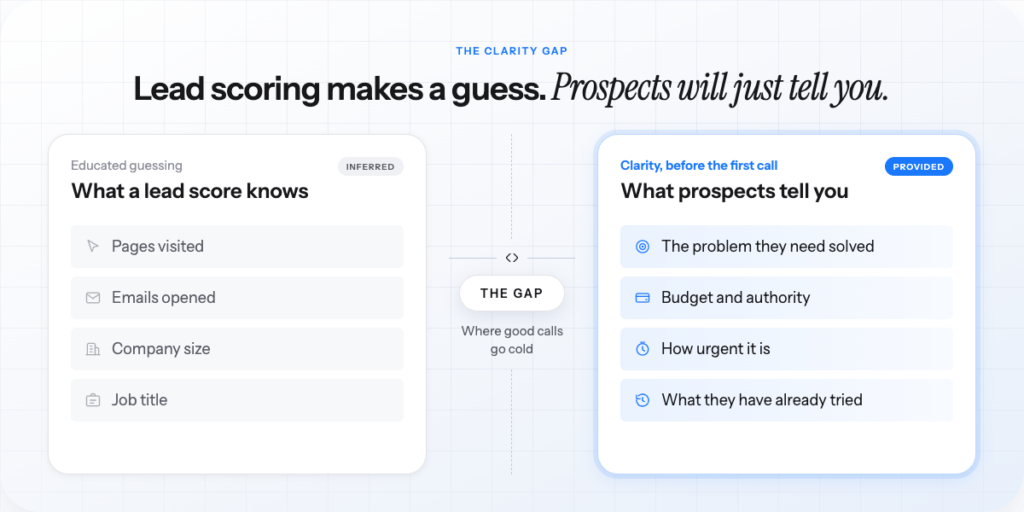
Traditional lead qualification tools predict who is a good lead based on proxy signals. A contact from a company with 200 employees in a target industry who visited your pricing page twice and opened three emails scores highly. They might be your next customer. Or they might be a competitor doing research, a consultant preparing a benchmark or a student writing a thesis.
The core problem is that behavioural signals and firmographic data describe the container, not the contents. They tell you about the company and the contact’s online behaviour. They do not tell you:
- What problem they are actually trying to solve
- Whether they have the budget and authority to buy
- How urgent their situation is
- What has already been tried and failed
- Whether they understand what they need or are still exploring
That is why high lead scores in CRMs frequently lead to disappointing discovery calls. The lead looked qualified on paper. On the call, it was clear they were months away from buying, or looking for something different entirely.
The clarity gap
Most lead qualification software tells you who a lead might be, based on signals and inference. The clarity gap is the distance between what a lead scoring model predicts and what your sales team discovers on the first call. Closing that gap requires a different kind of data.
A different approach: Zero-party data qualification
Zero-party data is data that a prospect gives you directly and intentionally. Instead of inferring what someone wants based on their behaviour, you ask them. They tell you.
This is not a novel concept in principle. Sales teams have always asked qualifying questions on discovery calls. The insight is that you can collect this data before the first call, at scale, automatically, and in a way that delivers genuine value to the prospect in return.
The mechanism is an interactive assessment or quiz funnel: a multi-step questionnaire that a prospect completes to receive a personalised score or insight about their situation. They answer questions about their business, their challenges, their goals and their readiness. In return, they get a personalised result that tells them something genuinely useful.
The seller receives a fully completed lead profile. Not a list of page views, but a set of direct answers to the qualification questions that matter most. And the prospect has self-selected into a qualification process, which is an unambiguous intent signal in itself.
Why zero-party data is more reliable for qualification
- Higher accuracy: leads tell you exactly what their situation is. No inference required.
- Immediate value exchange: the prospect receives something useful (a score, a diagnostic, a recommendation) in exchange for their time. This warms the relationship before the first call.
- Stronger intent signal: completing a 15 to 48 question assessment is a deliberate act. Leads who do it are serious. The ones who are not drop off before the lead capture step.
- GDPR-friendly and future-proof: zero-party data is freely given, clearly intentional and does not depend on third-party cookies or data brokers.
- Richer sales intelligence: individual answers to qualification questions are more actionable than a lead score derived from email open rates.
Want to see zero-party lead qualification in action?
ScoreApp’s interactive assessments collect the qualification data your sales team actually needs, directly from your leads.
Try ScoreApp free at scoreapp.com
How traditional lead qualification software compares to ScoreApp
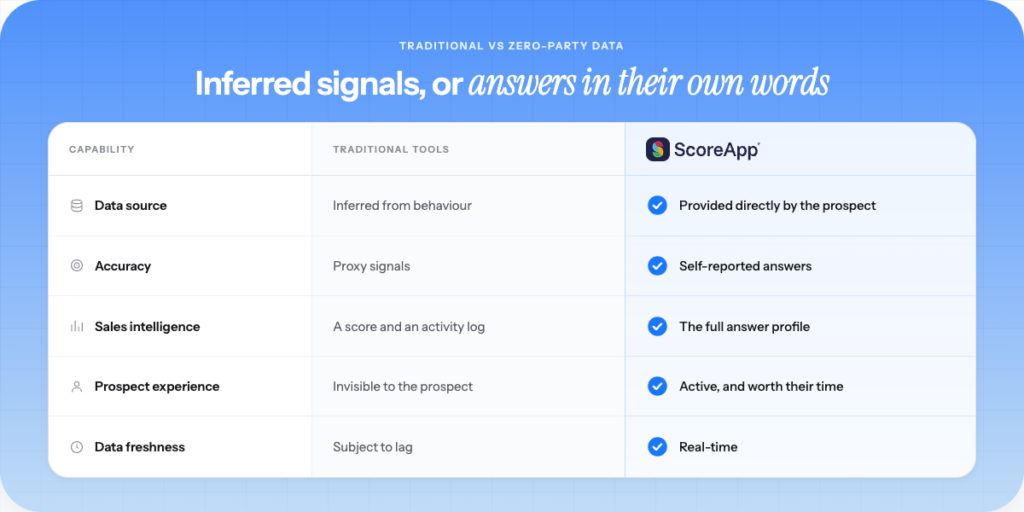
| Capability | Traditional tools (CRM / enrichment) | ScoreApp (zero-party data) |
|---|---|---|
| Data source | Inferred from behaviour and third-party databases | Provided directly by the prospect |
| Accuracy | Moderate: proxy signals, not direct intent | High: self-reported, intentional answers |
| Personalisation | Limited: segment-level, based on firmographics | Individual: each prospect gets a personalised result |
| Sales intelligence | Lead score and activity log | Full answer-by-answer profile with weighted score |
| Prospect experience | Invisible to the prospect | Active and value-generating: prospects receive useful insights |
| Data freshness | Subject to database lag and inaccuracy | Captured in real time, directly from the source |
| GDPR compliance | Depends on data source and consent model | Fully consensual: zero-party data is freely given |
What ScoreApp does as lead qualification software
ScoreApp is lead qualification and readiness software built on zero-party data. Its core mechanism is the interactive assessment or quiz funnel: a multi-step questionnaire that collects direct answers from prospects, scores them against weighted criteria and delivers personalised next steps automatically.
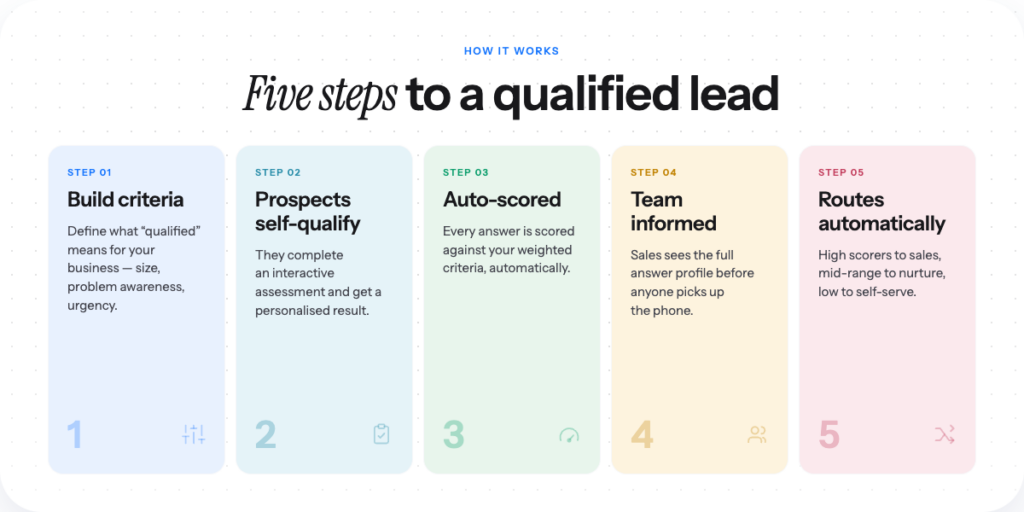
1. Build your qualification criteria once
You define what a qualified, ready prospect looks like for your business: the right company size, the right problem awareness, the right urgency level. ScoreApp’s AI builder then generates questions designed to surface this information, complete with scoring weights.
2. Prospects self-qualify through the assessment
Instead of a static contact form, prospects complete an interactive assessment and receive a personalised result. Their willingness to invest 5 to 15 minutes in an assessment is itself a strong qualification signal. Those who complete it are serious; those who are not drop off before the lead capture step.
3. Leads are automatically scored and segmented
Every completed assessment produces a lead score based on the weighted criteria you set. High scorers are flagged for immediate sales follow-up. Mid-range leads are entered into a nurture sequence. Lower-scoring leads receive a self-serve resource. The routing is fully automated.
4. Sales teams arrive informed, not cold
Before any discovery call, your sales team can review the lead’s exact answers in ScoreApp’s lead insights dashboard. They know the prospect’s situation, their challenges, their score and what they said they need. Calls start at a completely different level of insight.
5. Works across the entire customer journey
ScoreApp’s qualification engine applies equally to lead generation, sales qualification, client onboarding, event registration, hiring and application processes, and customer research. One platform handles multiple qualification moments across the journey.
How to choose the right lead qualification software
The right choice depends on where the qualification gap sits in your business.
If you have high lead volume and need to prioritise
Traditional lead scoring in a CRM like HubSpot, combined with enrichment from Apollo or Clearbit, is a solid foundation. The limitation is that you are still working with inference. Consider adding an interactive assessment layer to capture zero-party data for your highest-value segments.
If you have moderate lead volume but low sales conversion
The problem is usually qualification quality rather than quantity. Leads are booking calls but converting poorly. An interactive assessment at the top of the funnel, before any call is booked, filters for intent and fit, and gives your sales team genuine intelligence before they engage.
If your sales team relies on discovery calls to qualify
Every discovery call you take to find out whether a prospect is a fit is a cost. Interactive assessments move qualification upstream so your discovery calls start at a completely different point. The call confirms the fit rather than discovering it.
If you want to qualify leads at scale without growing your sales team
Zero-party data qualification scales without adding headcount. An assessment runs 24/7, qualifies every lead that completes it and delivers a scored profile to your team. The bottleneck shifts away from the first conversation and towards delivering work for clients who have already been identified as the right fit.
Frequently asked questions
What is the difference between lead scoring and lead qualification?
Lead scoring is a numerical ranking of leads based on criteria you define. Lead qualification is the process of determining whether a lead meets your criteria for active pursuit. Lead scoring is one tool used within lead qualification. Most traditional platforms use lead scoring based on behavioural and firmographic data. ScoreApp’s approach uses zero-party data, meaning direct answers from the prospect, to produce a more accurate qualification score.
Do I need lead qualification software if I already have a CRM?
A CRM stores and manages lead data but does not generate qualification data on its own. CRMs typically qualify leads using behavioural signals (email opens, page visits) and enrichment data from third parties. That is inference-based qualification. A platform built on zero-party data generates direct answers from prospects, which is more accurate and more actionable than anything a CRM can infer.
How does zero-party data qualification work with a CRM?
ScoreApp integrates with HubSpot, Salesforce, ActiveCampaign, Zoho and 30+ other CRM and marketing platforms. When a prospect completes an assessment, their score, individual question answers and contact details sync directly to your CRM. The zero-party data enriches your existing contact records rather than replacing your CRM workflow.
What types of businesses benefit most from ScoreApp’s approach?
ScoreApp works particularly well for service businesses, coaches, consultants, B2B SaaS companies, agencies and any business where discovery calls or sales conversations are a core part of the sales process. If your sales cycle includes a qualification conversation, ScoreApp moves that qualification upstream so every conversation is more informed and more likely to close.
Stop guessing which leads are worth your time
ScoreApp gives your sales team the qualification data they actually need, directly from your leads, before the first conversation.