
Someone sent me a message recently that deserved a proper answer:
“Can I just vibe code a quiz or a scorecard, and then I can avoid paying the subscription for ScoreApp?”
Fair question. I’m the co-founder of ScoreApp, so you already know where I land on it. But “because I sell the thing” isn’t an argument, so let me show my working instead.
First, I actually love vibe coding
This isn’t going to be an anti-AI piece. Vibe coding tools are extraordinary. The first time you use one properly it’s genuinely mind-blowing to see what you can create in a day.
On a recent flight, my wife and I built two websites we were thrilled with. It took minutes, not weeks. I use these tools constantly and I’d encourage anyone reading this to do the same.
So this isn’t about whether the tools work. It’s about knowing where the line sits – and there is a line.
Reason 1: everything is downstream from lead generation
Lead generation is one of the most important things in your business. Arguably the most important. Every other number you care about sits downstream of it.
Which means small differences don’t stay small. Here’s what that looks like in practice.
Say you generate 100 leads. 10% of them convert. Each client pays you $1,000. That’s $10,000.
Now improve each of those three levers by roughly 10%. Not by a lot. Just a bit better.
| Suboptimal setup | Slightly better setup | |
|---|---|---|
| Leads generated | 100 | 110 |
| Conversion rate | 10% | 11% |
| Average client value | $1,000 | $1,100 |
| Revenue | $10,000 | $13,300 |
Same spend. Same effort. 33% more revenue.
That’s what compounding looks like, and it’s why a slightly better lead qualification setup isn’t a slightly better outcome. Better leads convert at a higher rate. More data means you can pick and choose the better clients. Better-qualified clients let you charge more. Each improvement multiplies the last.
So yes, building it yourself might save you $40 or $50 a month. It might also cost you $3,000 a month in opportunities you never see, because you never knew they were there.
Reason 2: your time isn’t a free resource
A simple website might take 20 or 30 minutes to vibe code into something you like. Fine. Do that.
But an assessment campaign isn’t a simple website. It’s a landing page, a set of questions, scoring logic, data collection, a report generated on the back end, and a follow-up sequence. Even if you’re good at this, you’re looking at most of a day to get it working.
You might get the first 80% in a couple of hours. The last 20% is where the days go.
And it doesn’t end at launch. You’ll need to fix bugs and keep it current – call it another 10 hours every quarter or two. That’s 10 to 20 hours a year for one basic tool.
Here’s the part people miss. If you’ve got the mindset that says “I’ll just build this myself,” you won’t do it once. You’ll do it across five or ten pieces of software, because you’re chasing the same saving each time. Suddenly you’re spending 100 hours a year as an unpaid IT department.
Every great founder I’ve worked with does the opposite. They find the thing they’re wildly valuable at, they double down on it, and they outsource almost everything else. In a world of AI, becoming world-class at your one thing matters more, not less.
You don’t want to become the founder who cobbles things together.
Reason 3: general-purpose AI gives you general-purpose results
The vibe coding tools available to you are general-purpose. They’re trained on a broad sweep of what exists on the internet, which means they gravitate toward the average example of whatever you ask for.
Average is a problem when you’re building the thing your revenue depends on.
We’ve been able to observe over 150,000 marketing campaigns run on our platform. We can see which ones generate the most leads and which convert highest, filter the top 5% to the surface, and train our AI on those.
So the difference isn’t AI versus no AI. It’s AI trained on everything versus AI trained on what’s proven to work. One gives you something that looks right. The other gives you something built on the data that says it converts.
Reason 4: continuous improvement is a job, not a project
You might love what you build today. In three months it may well be out of date.
New tools appear. Integrations change. Best practice shifts. Keeping up isn’t a task you complete, it’s a process you maintain – and maintaining it across five or six things you’ve built yourself is not realistic alongside running a business.
We’ve recently been building out integrations with a range of other AI tools. That’s taken four people about a month. That’s the actual cost of staying current, and it’s the cost you quietly inherit the moment you decide to own the code.
Subscribing to software means outsourcing that permanently to a team whose entire job is thinking about it.
So what should you vibe code?
Here’s the test I use. Three questions:
- Is it static, or does it live? A one-page site that says what you do won’t change much. A lead generation campaign changes constantly.
- Is it mission-critical? If it breaks on a Tuesday and you don’t notice until Friday, how much did that cost?
- Does it need to get better over time, or just exist? Some things only need to work. Others decay unless they keep improving.
Static, low-stakes, fine as it is? Vibe code it. Genuinely, go and enjoy yourself.
Living, mission-critical, needs to compound? That needs more than a prompt and a hosting bill.
But look again at what those four reasons actually are. They’re not a list of arguments against vibe coding your lead generation. They’re a specification for what it would take to do it properly.
So we built that
The building part was never the problem. Generating a page is the easy bit, and it’s the bit AI is genuinely brilliant at. The problem is everything that has to be true after you hit publish.
So that’s what our AI landing page builder is.
You describe your business, your customer, and your offer in plain language. You get a landing page in minutes. Your next campaign doesn’t start with a blank page – it starts with a sentence. That’s the vibe coding experience, and we’re not pretending otherwise, because it’s a good experience.
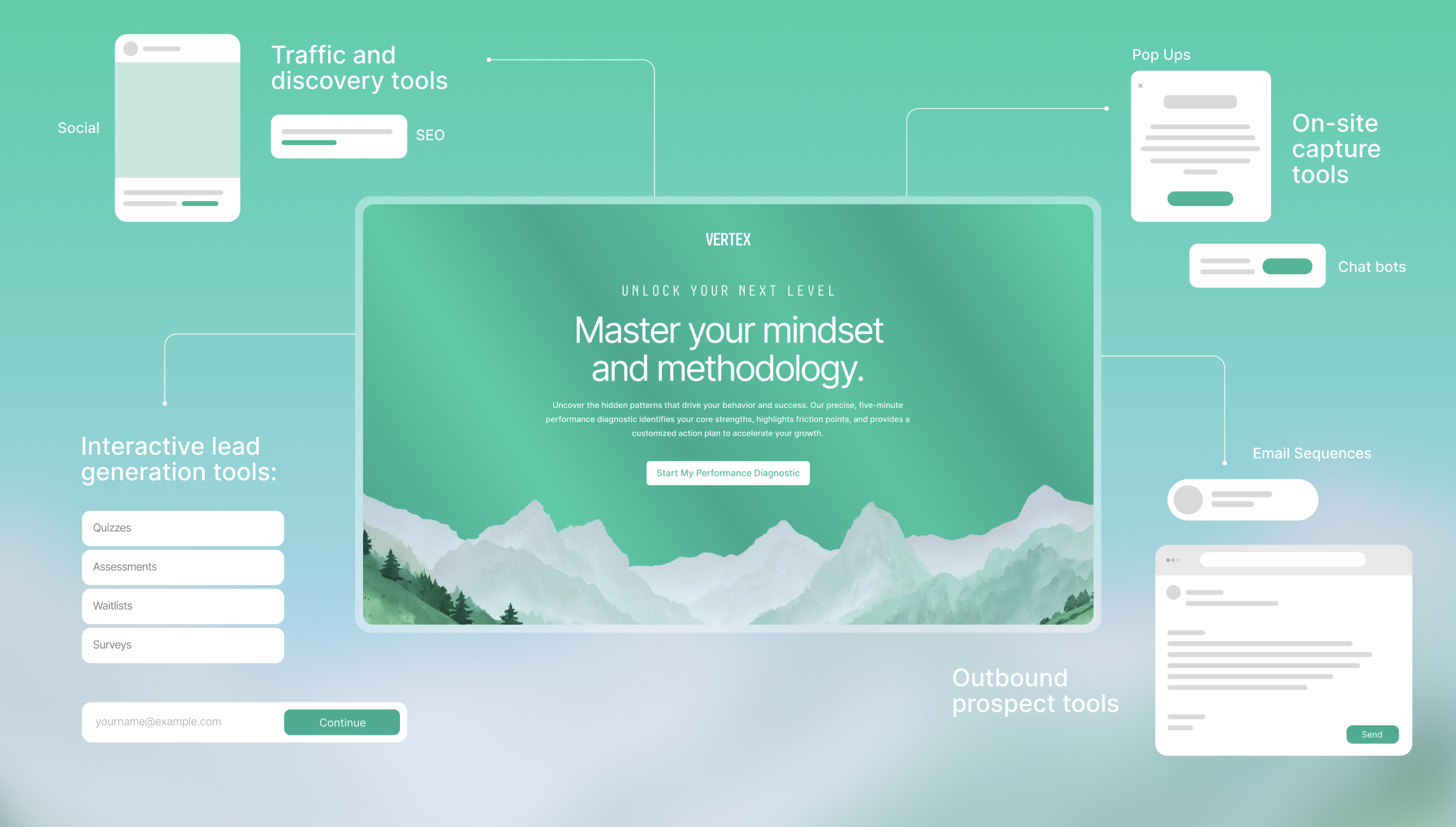
The difference is what comes attached to it. Hosting, SSL, DNS, and form integrations are handled. The page arrives already connected to lead capture, scoring, segmentation, personalized results, your CRM, email automation, and analytics. No plugins. No pixel setup. No Zapier spaghetti holding the whole thing together.
And it isn’t general-purpose AI, which matters more than it sounds. It’s trained on thousands of real scorecards and millions of real lead interactions, so it optimizes for what converts rather than what looks good. That’s the third reason on this list, answered directly.
So the honest answer to the original message is: yes, sort of. You can vibe code your lead generation. What you shouldn’t do is vibe code the ten other things that have to work before it means anything.
Build the campaign with a sentence. Then go and be world-class at your actual job.