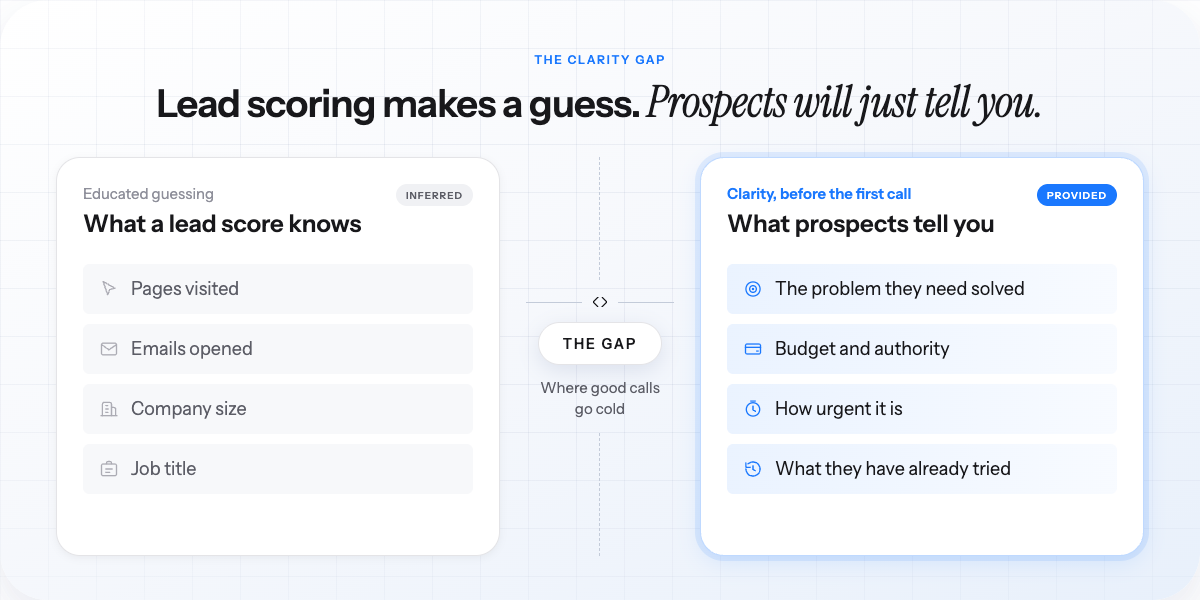


Lead qualification software covers a broader range of tools than most buyers realise when they start searching. At one end, you have data enrichment platforms that infer lead quality from firmographic and behavioural signals. At the other, you have interactive assessment tools that collect qualification data directly from prospects. In between, there are CRM scoring engines, scheduling tools and B2B automation platforms.
The right tool depends on what kind of qualification problem you are trying to solve. This guide covers eight of the strongest options, what each one is best at, and the types of business each one suits.
Quick Comparison: Best Lead Qualification Software in 2026
| Tool | Best for | Data type | Lead scoring | Personalised follow-up | Starting price |
|---|---|---|---|---|---|
| ScoreApp | Zero-party data qualification | Zero-party | Weighted | Yes, by score band | Free / from $39/mo |
| HubSpot | CRM-integrated lead scoring | First + third party | Behavioural | Via workflows | From $50/mo |
| Default | B2B inbound qualification | First + enrichment | Rules-based | Via automation | Custom pricing |
| Salesforce | Enterprise lead routing | First + third party | Einstein AI | Via CRM flows | From $25/user/mo |
| Chili Piper | B2B scheduling and routing | First party | Rules-based | Limited | From $30/user/mo |
| Apollo.io | Outbound data enrichment | Third party | Predictive | Via sequences | From $49/user/mo |
| Typeform | Survey-based lead capture | Zero-party | No | Basic | From $25/mo |
| Interact | Quiz-based lead segmentation | Zero-party | No | By segment | From $27/mo |
How we evaluated these tools
We assessed each platform across four dimensions: the type of data used for qualification (zero-party, first-party or third-party), the depth of lead scoring, the quality of personalised follow-up, and how well each platform suits service businesses and B2B teams whose sales rely on conversations rather than automated pipelines.
The 8 Best Lead Qualification Software Tools
1. ScoreApp (Best for zero-party data qualification)
Our pick: Best for service businesses, coaches and B2B teams
Most lead qualification software works by inferring who your leads are. ScoreApp works by asking them directly. That distinction is the source of its primary advantage over every other tool in this list.
The mechanism is an interactive assessment or quiz funnel. Prospects complete a multi-step questionnaire to receive a personalised score or insight about their situation. In doing so, they provide the answers to your qualification questions voluntarily and intentionally. You do not need to enrich that data. You do not need to infer intent from page visits. You have it, directly, from the person themselves.
ScoreApp’s weighted scoring engine turns those answers into a lead score based on criteria you define: the right company size, the right problem awareness, the right budget range, the right urgency level. High-scoring leads trigger a book-a-call prompt and a sales notification. Mid-range leads enter an automated nurture sequence. Lower-scoring leads receive a self-serve resource. The routing happens without any manual input.
Before any call, your sales team reviews the lead’s full answer profile in ScoreApp’s lead insights dashboard. They know who they are calling and what that person said before they pick up the phone. For service businesses and B2B teams where sales conversations are central to the pipeline, that pre-call intelligence changes outcomes.
ScoreApp also handles assessments, surveys, waitlists, event registration and application forms using the same scoring engine, covering multiple qualification moments across the customer journey.
Strengths
- Zero-party data: the highest-quality qualification data available
- Weighted scoring against criteria you define, not behaviour you infer
- Personalised results pages per score band, applied automatically
- Lead insights dashboard with full answer-by-answer profiles
- AI builder generates questions, scoring and results pages from a description
- Native integrations with HubSpot, Salesforce, ActiveCampaign and 30+ tools
- Covers the full customer journey beyond lead generation
- Free plan available
Limitations
- Less suited to high-volume B2B SaaS pipelines where enrichment and intent data are the primary qualification mechanism
- Not a scheduling or routing tool in the traditional RevOps sense
Pricing: Free plan available. Paid plans from $39 per month.
2. HubSpot (Best for CRM-integrated lead scoring)
Good choice for: Teams that want lead qualification built into their CRM
HubSpot is one of the most widely adopted CRM platforms for small and mid-sized businesses, and its lead scoring capabilities are well-integrated into its marketing and sales workflows. You can assign scores based on demographic criteria (company size, industry, job title), behavioural signals (email opens, page visits, form submissions) and lifecycle stage.
For teams already using HubSpot as their primary CRM, the integrated approach has clear advantages. Lead scores update in real time, workflows trigger automatically when thresholds are crossed and marketing and sales teams share the same data.
The limitation of HubSpot’s lead scoring is the same limitation that applies to most CRM-based scoring: it works with the data available in the CRM, which is primarily inferred from behaviour and enriched from third-party sources. It does not collect direct answers from prospects about their situation, readiness or specific challenges. That gap becomes apparent when your sales team starts conversations with leads that scored well on paper but turn out to be poor fits.
Strengths
- Lead scoring natively integrated with the CRM and marketing automation
- Scores update in real time based on activity across connected channels
- Strong workflow automation when score thresholds are reached
- Comprehensive native tools covering email, ads, landing pages and more
- Well-established integration ecosystem
Limitations
- Lead scoring based on inferred behavioural and firmographic data, not direct prospect answers
- Full Marketing and Sales Hub functionality requires significant investment
- Complex setup for advanced lead routing and scoring models
- No pre-call lead insights dashboard showing individual qualification answers
Pricing: From $50 per month for Marketing Hub Starter. Full qualification and automation features require higher tiers.
3. Default (Best for B2B inbound qualification automation)
Good choice for: B2B SaaS and high-growth teams automating inbound lead flows
Default is built specifically for B2B inbound qualification and routing automation. It combines form capture with real-time lead enrichment from Apollo and Clearbit, rules-based routing to sales reps, and instant scheduling. The focus is on reducing speed-to-lead: getting qualified inbound leads in front of the right sales rep as quickly as possible.
For B2B SaaS companies with established inbound demand and structured sales processes, Default addresses a specific and painful problem well. It removes manual steps between a form submission and a booked meeting, which can meaningfully improve conversion rates on inbound leads.
Default’s qualification model is enrichment-based: it determines lead quality by pulling firmographic and technographic data from third-party databases and comparing it against rules you set. This is fast and scalable, but it still relies on inference rather than direct prospect data. For companies where the primary qualification bottleneck is routing speed and rep assignment, it is a strong solution.
Strengths
- Purpose-built for speed-to-lead in B2B inbound flows
- Real-time enrichment from Apollo and Clearbit enriches leads at the point of capture
- Automated routing and scheduling reduces manual work significantly
- Clean, no-code workflow builder accessible to non-technical teams
- Integrates with HubSpot and Salesforce as an orchestration layer
Limitations
- Qualification based on enrichment and rules rather than direct prospect data
- Not suitable for service businesses or coaches where conversational qualification is the norm
- Custom pricing makes cost comparison difficult
- Less applicable outside B2B SaaS inbound contexts
Pricing: Custom pricing. Not publicly listed.
4. Salesforce (Best for enterprise lead routing and scoring)
Good choice for: Large enterprise sales teams with complex routing requirements
Salesforce is the dominant CRM for enterprise sales teams and its Einstein AI lead scoring capability is one of the more sophisticated predictive scoring models on the market. It analyses historical CRM data to predict which leads are most likely to convert, based on patterns across thousands of previous deals.
For large organisations with high lead volumes, established sales processes and significant CRM data to train scoring models against, Salesforce’s approach can be genuinely powerful. The platform also handles complex lead routing, territory management and multi-stage pipeline workflows at a scale few others can match.
The barriers are the same as with any enterprise CRM: cost, implementation complexity and the time needed to build and maintain meaningful scoring models. For smaller teams or service businesses, Salesforce is significant overkill. For teams where leads need to be scored and routed across large sales organisations with defined territories, it is the market leader for a reason.
Strengths
- Einstein AI predictive lead scoring based on historical CRM patterns
- Handles complex lead routing, territory management and enterprise workflows
- Extensive customisation and integration capabilities
- Market-leading for large sales organisations with high lead volumes
Limitations
- High implementation cost and significant ongoing maintenance
- Scoring based on historical data and predictions, not direct prospect answers
- Heavy for small to mid-sized businesses or service-based sales processes
- Requires significant CRM data to produce reliable predictive scores
Pricing: Sales Cloud from $25 per user per month. Einstein AI features require higher tiers.
5. Chili Piper (Best for B2B meeting scheduling and lead routing)
Good choice for: B2B teams that need instant scheduling and rules-based routing
Chili Piper is a scheduling and routing platform that sits between a form submission and a calendar booking. When a qualified lead fills in your form, Chili Piper routes them to the right sales rep and books the meeting instantly, without the back-and-forth of manual scheduling.
For B2B teams where speed-to-meeting is a critical metric, Chili Piper delivers a clear improvement over manual follow-up. The one-click scheduling experience reduces drop-off between lead submission and booked call, and the routing logic handles territory, seniority and availability rules automatically.
It is important to note that Chili Piper is a scheduling and routing tool, not a qualification tool in its own right. It relies on the qualification criteria you have already defined in your form or CRM to determine who gets routed and where. The qualification decision happens upstream. Chili Piper handles what happens next.
Strengths
- Instant meeting scheduling at the point of lead capture reduces drop-off significantly
- Rules-based routing handles territories, rep availability and seniority
- Clean integration with HubSpot, Salesforce and other CRMs
- Automated reminders and follow-up reduce no-show rates
Limitations
- A scheduling and routing tool, not a qualification platform: relies on upstream qualification
- Pricing structure can be confusing: per-user fees plus platform fees
- Limited value without an existing CRM and lead qualification process
- Not suited to service businesses or contexts where qualification happens in conversation
Pricing: From $30 per user per month plus a platform fee ranging from $150 to $1,000 per month.
6. Apollo.io (Best for outbound prospecting and data enrichment)
Good choice for: Outbound sales teams that need contact data and lead intelligence
Apollo.io is a sales intelligence and engagement platform with a contact database of over 200 million records. For outbound prospecting teams, it combines contact data discovery with email sequencing and engagement tracking in a single platform. Lead qualification in Apollo is primarily driven by filters and intent signals: you define the firmographic and technographic profile of your ideal prospect and Apollo identifies matching contacts.
For teams whose primary qualification challenge is finding and reaching the right people rather than scoring inbound leads, Apollo is a strong tool. The data quality is generally good, the search filters are powerful and the outbound sequencing features reduce the manual work of outbound prospecting.
For inbound qualification or pre-call intelligence on warm leads who have already expressed interest, Apollo is less applicable. It is primarily an outbound tool built around finding prospects rather than qualifying ones who have already found you.
Strengths
- Extensive contact database with 200 million+ records for outbound prospecting
- Powerful search filters including firmographic, technographic and intent signals
- Combined prospecting and email sequencing reduces outbound tool stack complexity
- Useful as a data enrichment source for CRM records
Limitations
- Primarily an outbound prospecting tool rather than an inbound qualification platform
- Data accuracy varies: some users report outdated contact records
- Outreach emails can end up in spam folders
- Pricing via credits model can be difficult to predict at scale
Pricing: From $49 per user per month. Enterprise plans available with custom pricing.
7. Typeform (Best for survey-based qualification and conversational data collection)
Good choice for: Collecting self-reported lead data through conversational forms
Typeform collects zero-party data through its conversational one-question-at-a-time format, which means it shares something important with ScoreApp: it asks prospects directly rather than inferring from behaviour. The difference is in what it does with those answers.
Typeform collects the responses and passes them to you or to your CRM. It does not score leads against weighted criteria, does not produce personalised results pages based on lead quality and does not generate a pre-call insights dashboard. The qualification analysis is manual.
For teams that want a well-designed, conversational way to collect detailed information from prospects and are comfortable doing their own scoring and segmentation downstream, Typeform is a solid option. For teams that want the qualification to happen automatically, it does not complete the process.
Strengths
- Excellent conversational experience improves completion rates on longer forms
- Collects direct, self-reported data (zero-party) rather than behavioural inference
- Strong integrations with HubSpot, Salesforce and other CRMs
- Good template library and brand customisation
Limitations
- No weighted lead scoring: qualification analysis must be done manually or via CRM rules
- No personalised results based on lead quality score
- No lead insights dashboard for pre-call review
- Response-based pricing can become expensive for high-volume use
Pricing: From $25 per month. Response limits apply.
8. Interact (Best for quiz-based audience segmentation)
Good choice for: Audience segmentation through personality quizzes and opt-in lead magnets
Interact is a quiz platform built around audience segmentation and list growth rather than sales qualification. Its personality quiz format has proven effective as a lead magnet for course creators, membership businesses and content-led brands. Prospects complete a quiz to find out which “type” they are, and Interact routes them into the corresponding email sequence.
The platform collects zero-party data in the same sense that Typeform does: prospects tell you about themselves voluntarily. The distinction from a qualification standpoint is that Interact maps answers to personality types or audience segments rather than to a commercial readiness score. It is designed to understand who your audience is rather than which part of your audience is ready to buy.
For businesses focused on list growth and audience nurturing, Interact serves its purpose well. For businesses focused on pre-qualifying sales leads against defined fit criteria, it is not the right tool.
Strengths
- Strong personality quiz format proven for list growth and lead magnet campaigns
- Good results page experience and email sequence integration
- Accessible for non-technical users with a straightforward builder
- Effective for audience segmentation in creator economy and content-led businesses
Limitations
- No commercial lead scoring: designed for audience segmentation, not qualification
- Results tied to personality archetypes rather than readiness or fit scores
- Limited analytics beyond completion and opt-in rate
- Not suited to B2B qualification or service-business sales contexts
Pricing: From $27 per month.
How to choose the best lead generation software
What type of qualification problem do you have?
If your problem is finding the right people to contact in the first place (outbound), tools like Apollo.io, HubSpot and Salesforce give you the data and infrastructure to identify and route prospects at scale. If your problem is understanding which of the leads who have already found you are worth your time, zero-party data tools like ScoreApp give you direct answers rather than inferred signals.
Is your sales process conversation-led or automated?
Businesses with high-touch, conversation-based sales processes (consultants, coaches, agencies, professional services) benefit most from pre-call qualification intelligence. Knowing exactly who you are speaking to before you dial is worth more than a lead routing algorithm. Businesses with high-volume, automated sales motions (SaaS self-serve, e-commerce, performance marketing) benefit more from routing speed and enrichment depth.
How much of your qualification should happen before the first call?
If your discovery calls are currently functioning as first-stage qualification conversations, you are paying for that qualification with sales team time on every call. Moving qualification upstream, before the call, through an interactive assessment changes the economics significantly. Every call your team takes starts with a lead that has already been scored and profiled.
What data do you want to qualify with?
Third-party enrichment data (firmographics, technographics, intent signals) tells you about the company and what the contact appears to be doing. Zero-party data tells you what the prospect actually said about their situation, goals and readiness. For most service businesses, zero-party data is more accurate and more actionable for qualification than anything a database can infer.
Frequently Asked Questions
What is the difference between lead scoring and lead qualification?
Lead scoring assigns a number to a lead based on criteria you define. Lead qualification is the broader process of determining whether a lead is worth pursuing. Lead scoring is one input into lead qualification. The key question is what data your scoring model uses: behavioural signals and firmographic data (inference) or direct answers from the prospect (zero-party data). The latter tends to produce more accurate qualification outcomes for service-based businesses.
Which lead qualification software is best for coaches and consultants?
For coaches, consultants and service businesses where qualifying a prospect before a discovery call matters, ScoreApp is the strongest option in this list. Its weighted scoring engine produces lead scores based on direct prospect answers, its personalised results pages deliver value to the lead immediately, and its lead insights dashboard gives practitioners the pre-call intelligence they need to have genuinely informed first conversations.
Does lead qualification software replace a CRM?
No. Lead qualification software works alongside your CRM rather than replacing it. CRMs manage the lead relationship and store activity data. Qualification software generates the qualification data that enriches those CRM records. ScoreApp, for example, syncs lead scores and individual question answers directly to HubSpot, Salesforce and other CRM platforms.
How do I know which leads are actually qualified?
That depends on your own definition of a qualified lead. The first step is to define what fit and readiness look like for your specific business: the right company size, the right problem awareness, the right budget, the right urgency level. Once you have defined those criteria, a platform with weighted scoring can apply them automatically. Without that definition, every lead looks equally qualified on paper.
See how ScoreApp qualifies leads differently
Ask your prospects directly. Score them automatically. Arrive informed on every call. Free to start.