5 Marketing Mistakes That Are Killing Your Lead Generation

Most marketing advice sounds true right up until someone tests it against real numbers. Daniel Priestley, entrepreneur and co-founder of ScoreApp, has generated hundreds of thousands of leads and tens of millions in sales over the past decade, and his experience contradicts several pieces of conventional wisdom that keep circulating in the marketing world. Five specific beliefs stand out as costly, and each one is worth examining before you build your next campaign around it.
Quality Over Quantity Gets the Order Backwards
The phrase gets repeated so often it starts to sound like scripture: chase quality leads, not quantity. Priestley argues the opposite is true. Finding a great client is a needle in a haystack, and you need the haystack before you can find the needle. Businesses that generate just enough leads never create the demand and supply tension that signals momentum to a market.
Glastonbury Festival illustrates the point well. Every year roughly 700,000 people register wanting a ticket, while only around 136,000 tickets actually go on sale. That gap between registrations and availability is exactly what makes tickets sell out in minutes. The festival does not chase quality registrants. It chases volume, then lets scarcity do the sorting.
Priestley points to a business coach who needed only ten clients but still spoke in front of an audience of more than 300 CEOs. Quantity came first, and quality clients emerged from within it. The practical takeaway is to build a scalable lead magnet, an assessment, or a webinar that pulls in volume, then add a qualifying step that separates genuine buyers from browsers. A scorecard style assessment built through purpose built lead generation software can do exactly that, turning a flood of interest into a sorted list of real prospects.
This distinction matters because most founders quietly optimise for the wrong metric in the first place. Chasing a small, hand picked list feels safer, but it starves the business of the raw data needed to spot patterns. A wider top of funnel, paired with the right qualifying questions, reveals who genuinely fits and who does not, faster than a narrow, cautious approach ever could.
Nurture Sequences Rarely Deliver the Boom
Automated nurture sequences are treated as a near magical route to sales, yet Priestley says the results tell a different story. Companies pour energy into long email drip campaigns and see only a trickle of buyers come through. The majority of people convert quickly, and only after a specific frustration is named and solved for them directly.
For years, Priestley skipped nurture sequences entirely. Instead, he focused on identifying the exact problem a prospect faced, then showing them precisely how his business solved it, whether through a webinar, a sales meeting, or a report. Presented this way, people bought within a few weeks rather than months. A nurture sequence still has a place once a business is established and wants to catch trailing sales over six, twelve, or twenty four months, but early stage businesses that lean on nurturing instead of a clear problem and solution pitch are chasing the trickle instead of the boom.
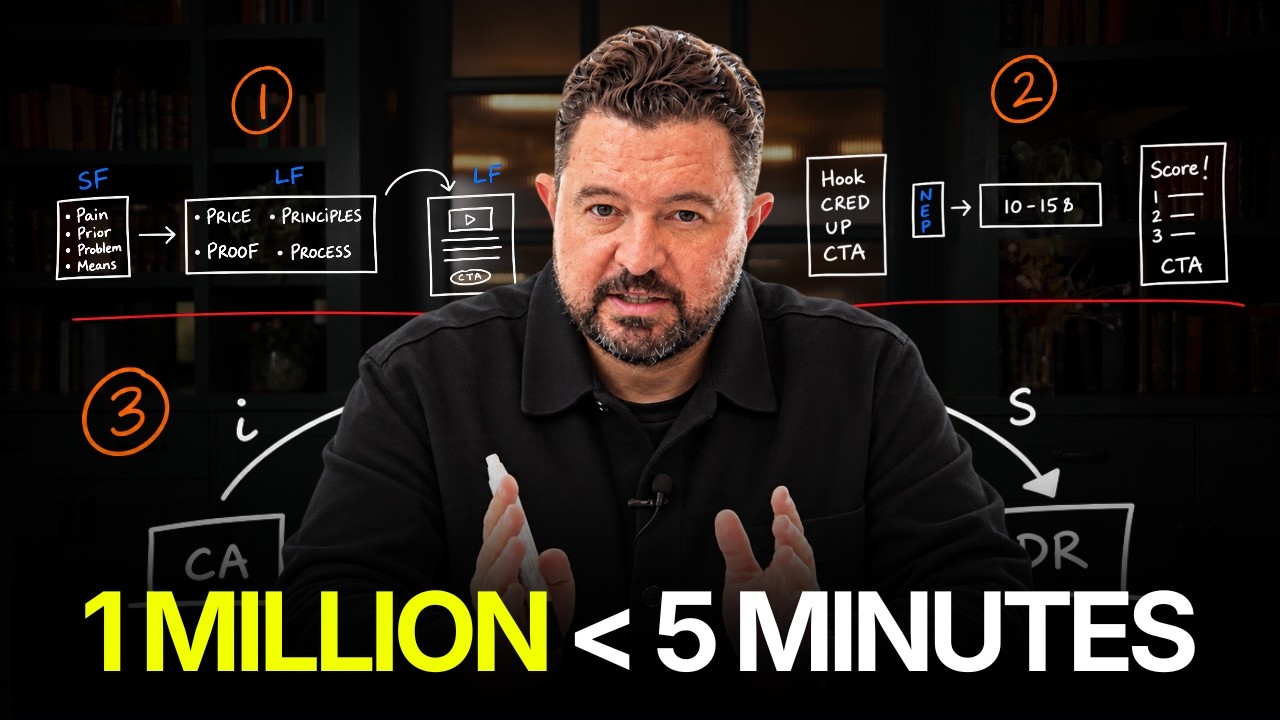
Businesses looking to structure that problem and solution message more deliberately can review the reader questions and answers in this breakdown of a million dollar lead generation approach, which covers how sharper qualification changes conversion speed.
Testing Ads Early Burns Cash You Do Not Have
Running paid test campaigns to see which headline or offer performs best sounds sensible, until the bill arrives. Priestley notes that properly testing a handful of headlines, value propositions, or offers through paid ads typically costs somewhere between two and four thousand dollars, money most early stage businesses simply do not have to spend on experimentation.
His alternative below a million dollars in revenue is direct messaging, roughly a hundred a day, testing different hooks and offers while actually talking to people. It is slow and takes real effort, but it is close to free, and it produces a clear read on what makes a customer tick. Priestley describes a message format that follows this pattern, “I did something special with a certain type of client. We got a measurable result and I can explain it step by step. Would you like to know more about that?” He recommends sending roughly the first three thousand direct messages inside the first thirty days before moving toward paid ad testing at all.
A Marketing Budget Is the Wrong Frame Entirely
Setting aside a fixed marketing budget, fifty thousand or a hundred thousand for the year, is a habit Priestley sees even among funded, experienced businesses. He calls it a recipe for wasting money, because it treats marketing as a cost rather than a measurable input tied to revenue.
The better frame is an allowable cost per lead or an allowable cost per sale. If a product sells for five thousand dollars and ten percent of that is an acceptable marketing cost, the allowable cost per sale becomes five hundred dollars. Once the conversion ratio from lead to sale is known, say one in ten, the allowable cost per lead follows directly, fifty dollars in this example. Every business Priestley has scaled into seven or eight figures worked from that formula rather than a fixed annual number, which effectively creates an infinite marketing budget as long as the guardrails hold.
Brand Building Comes After Sales, Not Before
Priestley is direct about this one: do not try to build a brand in the early days. Brand building is expensive, slow, and largely irrelevant when a business is still finding its footing. People are exposed to hundreds of messages daily and will not remember a business long enough for a brand to form organically. What actually earns attention is naming a problem clearly, offering a credible solution, and giving people an obvious next action to take.
That does not dismiss the value of knowing, liking, and trusting a business before buying from it. Priestley argues that trust gets built into the sales process itself through credentials, story, and content that walks a prospect toward a decision, not through years of patient brand investment. A noisy market punishes the long game. The practical move is a strong call to action: a form, an assessment, or a workshop registration, followed by a clear sales conversation. Readers who want a deeper look at structuring that kind of qualification-first approach can find more detail in this breakdown of principles fast growth companies actually use.
Businesses that skip this step often confuse patience with strategy. Building a following slowly feels responsible, but a founder without cash flow cannot afford to wait years for recognition to compound. Naming the problem clearly and offering a specific fix, backed by a real call to action, closes that gap much faster than steady brand accumulation ever will.
The Assessment as a Call to Action
Priestley compares recommending a solution without an assessment first to a doctor putting an arm in a cast before running a single test. Nobody would trust a diagnosis skipped like that, and the same logic applies to marketing. An online assessment lets a prospect self diagnose their problem before a business proposes a fix, which builds credibility into the very first interaction.
This approach works particularly well for consultants, coaches, agencies, and B2B software businesses selling anything solution oriented. Rather than opening with a pitch, the sequence becomes assessment first, then the recommendation, then the sale. Businesses that want to try ScoreApp free can build that kind of diagnostic assessment using the platform’s interactive scorecard framework, which turns straightforward questions into segmented, personalised results rather than a flat lead form. The scoring logic and segmentation behind a scorecard does more of the qualifying work automatically, so the quantity of leads Priestley recommends chasing does not turn into a quality nightmare for a sales team.
None of these five points require a bigger budget or a longer runway. They require a different sequence: get volume first, qualify fast, message people directly before paying to test, tie spend to allowable cost per lead, and let a clear call to action do the work that a slow burning brand campaign cannot. Start with one change, most likely the assessment as your qualifying step, and measure what happens to your conversion speed over the next thirty days.