Why Your Sales Process Breaks Down (And How to Fix It)

A sales team that misses its numbers rarely has a motivation problem. More often, one part of a four part chain has quietly broken, and everything downstream suffers for it. Daniel Priestley, founder of ScoreApp, has spent twenty five years building sales teams, and he traces almost every underperforming sales process back to one of four specific failure points.
The four pillars of a sales process that actually works
Priestley breaks a functioning sales operation into four connected parts: sales culture, a warm up process, sales rhythm, and the sales conversation itself. Each one supports the next. Get one wrong and the whole system strains, no matter how talented the people running it are.
1. Sales culture
Priestley identifies three cornerstones of a strong sales culture: ambition, professionalism, and accountability. Ambition is the hunger to hit targets and earn commission. Professionalism balances that drive with proper training, accurate records, and reliable follow up. Accountability means a salesperson accepts that results are the only truth. If the numbers are not there, the fix starts with them, not with excuses about lead quality or market conditions.
Hire for these three traits and train for them consistently, and the foundation of the sales team becomes far more stable.
2. The warm up process
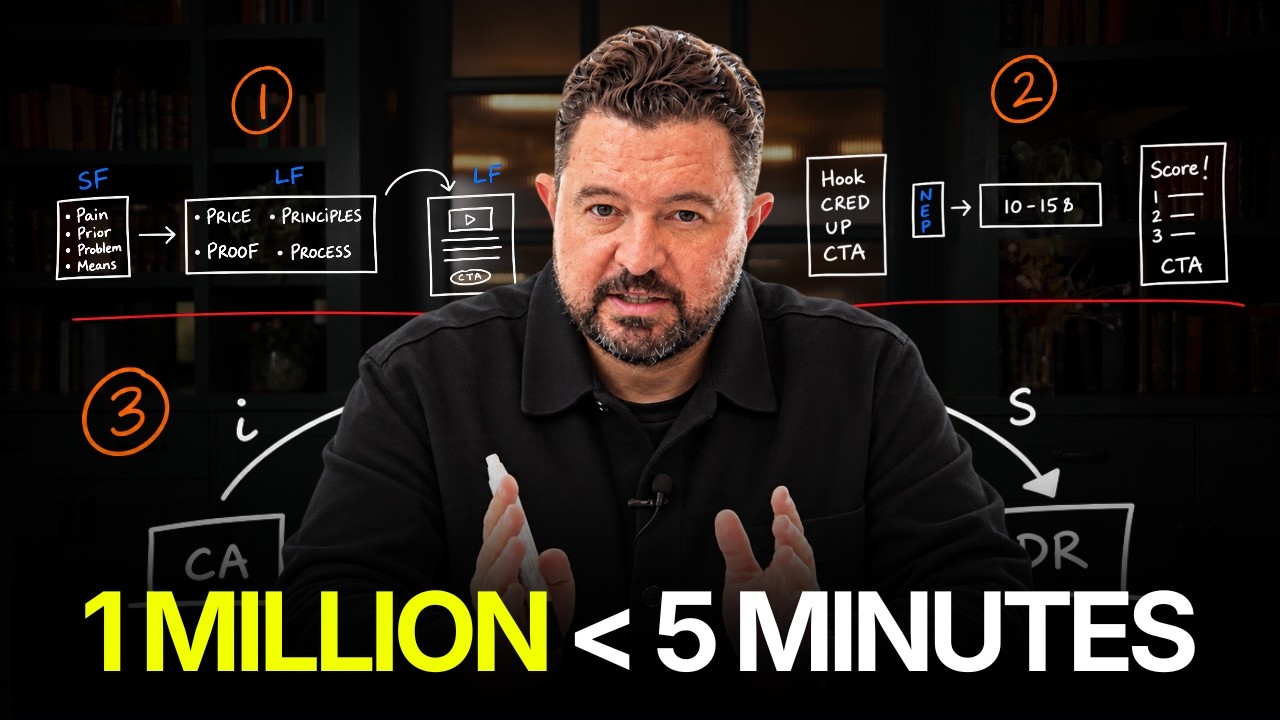
Handing a salesperson a cold lead wastes time for everyone involved. Priestley recommends a structure he calls short form, long form, lead form. A short piece of content, such as a social post or an ad, first creates awareness. A long form asset, whether that is a video, a report, or a podcast episode, builds understanding of the value on offer and demonstrates proof through other clients’ results. Only after that does a lead form invite someone to signal genuine interest.
He points to a rule of thumb he calls 7-11-4: roughly seven hours of consideration, eleven interactions, and four different platforms or touchpoints before someone is ready to buy. The goal is to front load as much of that warm up onto digital assets as possible, so a salesperson only ever talks to someone who has already done the work of getting comfortable with the offer.
This is where an interactive scorecard earns its place in the funnel. Instead of marketing an offer directly, a business can market a short assessment that helps a prospect self diagnose whether they actually need what is on offer. Priestley describes one entrepreneur who switched her ad spend from promoting a service directly to promoting an assessment instead, and the shift produced two and a half million dollars in sales inside six months. The assessment did two jobs at once: it let prospects work out for themselves whether they were a fit, and it meant that by the time a conversation happened, the lead was already warm.
A tool like ScoreApp exists precisely for this stage. It replaces a generic contact form with a structured set of questions that turns a visitor’s answers into a clear next step, so the warm up happens automatically rather than depending on a salesperson’s charm.
3. Sales rhythm
Feast and famine kills morale faster than almost anything else in a sales team. Priestley uses the acronym LAPS to track rhythm: leads, appointments, presentations, and sales. If a salesperson receives sixty leads a week and reliably converts them into twelve appointments, ten presentations, and three sales, that ratio becomes the benchmark to protect. A team drowning in two hundred leads one month and starved of ten the next cannot build any consistency, and consistency is what keeps a sales floor motivated and predictable.
4. The sales conversation
Priestley is skeptical of the idea that natural charisma alone makes a great closer. He calls it a myth, or at best something that cannot scale across a whole team. Instead, he advocates for a repeatable ten step framework: framing the call, building rapport, understanding the current reality, understanding the desired reality, uncovering obstacles, sharing insight, explaining methodology, recommending a solution, discussing objections, and closing or agreeing next steps.
A framework like this is trainable in a way that natural conversational talent is not. It also gives a manager a clear diagnostic tool. When a deal falls through unexpectedly, a salesperson working from this structure can point to exactly which step broke down, rather than shrugging and blaming bad luck.
Why the warm up stage carries so much weight
Of the four pillars, the warm up process is often the one businesses neglect most, largely because it sits between marketing and sales and can fall through the cracks of both. Priestley’s insight is that a well designed assessment does more than generate a name and an email address. It surfaces a prospect’s current reality and desired reality before a human ever gets on a call, which means the salesperson walks into the conversation already holding half the discovery work done for them.
This is a meaningful difference from a standard lead capture form. A form collects an email address. A scorecard style assessment collects answers that reveal fit, readiness, and motivation, the kind of zero party data that a prospect volunteers rather than data inferred from clicks or browsing behaviour. That distinction matters because assumptions based on behaviour can suggest interest, but they rarely explain why someone is interested or what they actually need next.
Scoring your own sales process
Priestley suggests a simple self audit. Rate each of the four pillars out of ten: sales culture, warm up process, sales rhythm, and sales conversation. A low score anywhere points to where attention is needed first, rather than guessing at a fix or assuming the whole system needs an overhaul.
For many founders, the warm up process scores lowest, simply because it requires infrastructure that most small businesses never got around to building. An assessment that pre qualifies leads before they reach a calendar closes that gap without adding headcount. Once that piece is in place, the sales rhythm tends to stabilise too, because the leads reaching a salesperson are already closer to a decision.
Businesses that have implemented this kind of system report similar patterns. One approach documented in a one hour assessment system built to add seven figures in leads shows how quickly a scorecard can be built and deployed once a business understands its ideal customer. The barrier to entry is lower than most people assume, since the setup itself can be handled largely by AI tools that build a full assessment from a short description of who a business serves.
Turning the framework into practical questions
Before adopting a ten step conversation framework wholesale, it helps to test a smaller version of it. A useful exercise is reviewing five questions worth asking before the next sales call and mapping them against the current reality and desired reality steps Priestley describes. If a salesperson cannot answer those questions confidently before dialling in, the warm up process upstream probably needs strengthening rather than the conversation script itself.
The broader lesson is that a sales process is not a single lever. Culture without rhythm produces burnout. Rhythm without a warm up process produces wasted calls. A polished conversation framework cannot rescue a lead that never should have reached a salesperson in the first place. Treating all four pillars as one connected system, rather than four separate departments, is what actually produces the predictable results Priestley describes.
A practical next step
Start with the pillar that scores lowest on your own honest audit. For most growing businesses, that will be the warm up process, since it is the piece most often skipped entirely. Building a short online assessment gives prospects a way to self diagnose their situation and gives a sales team a head start on every conversation that follows. Trying ScoreApp free is a fast way to test whether this approach fits your business before committing significant time to a full rebuild of the sales process.
Once the warm up stage is solid, revisit sales rhythm and the conversation framework with fresh eyes. A steady, well qualified stream of leads makes both far easier to get right.