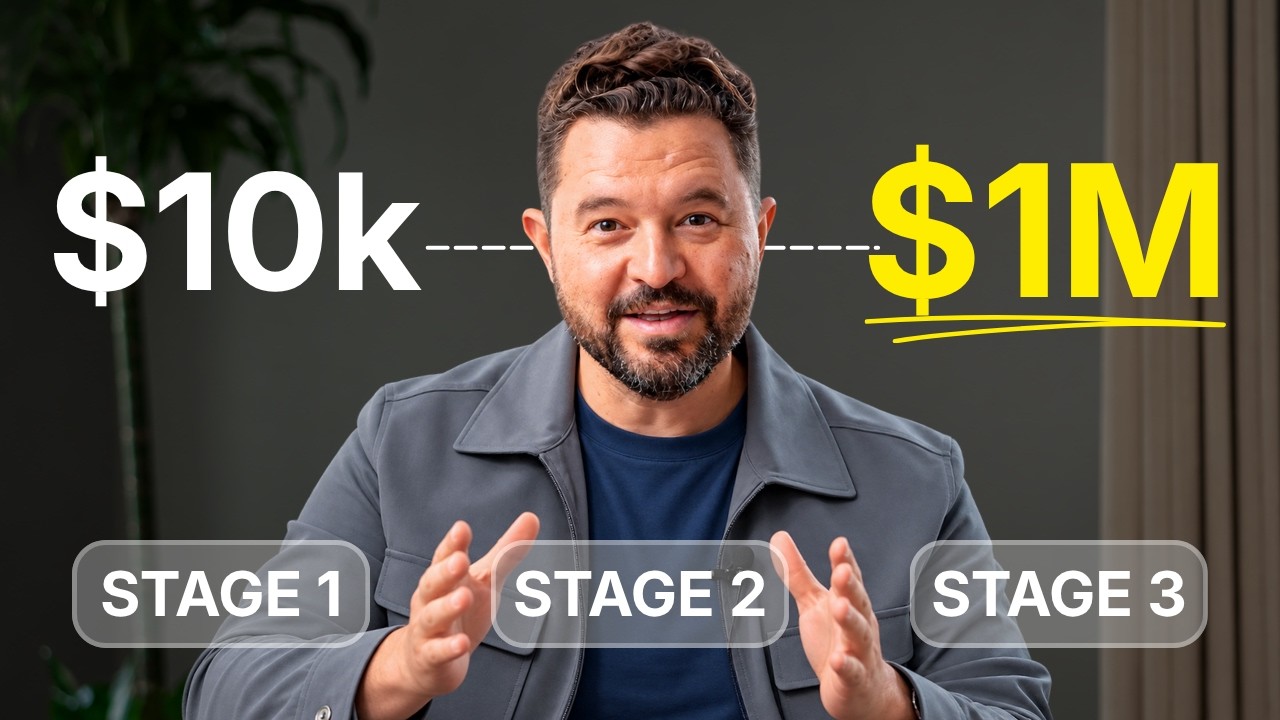

Most business owners trying to hit their first million assume they need more tactics, more channels, and more complexity. Daniel Priestley argues the opposite. Getting to seven figures of revenue is not about doing a hundred things adequately. It is about doing six things exceptionally well, in sequence, until the system compounds.
Priestley is clear that scaling a business to $10 million a year is genuinely hard and requires mastery across many moving parts. But that first million? That is a focus problem, not a complexity problem. Here are the six things he says will get you there.
One Ideal Customer Persona
The starting point is radical specificity about who you serve. Priestley describes the ideal customer persona as someone with one frustration they want to escape, one outcome they are chasing, and one obstacle standing between where they are now and where they want to be.
He points to the early days of ScoreApp as a practical example. When the platform launched, the team focused entirely on business coaches and consultants who had written a book. That narrow profile was chosen deliberately. Author-consultants had the intellectual property needed to run a scorecard marketing campaign, they were capable of generating $20,000 to $40,000 per client, and they had a clear reason to want a tool that helped them win clients through online assessments. The specificity made everything else easier.
Giving your ideal customer a name, understanding their internal world, and building everything around that one person is the foundation the other five steps rest on. Without it, the rest of the system has nothing to aim at.
One Platform
Once you know who you are looking for, the next step is choosing a single place to find them. Priestley is direct about this: spreading attention across multiple platforms produces lukewarm results on all of them. Concentrating on one produces mastery.
For B2B businesses, that might mean LinkedIn or YouTube. For others, it could be Instagram, Facebook, or even an offline network. The channel matters less than the commitment to it. Priestley describes a contact who built over a million LinkedIn followers while barely maintaining a presence anywhere else. That focused audience became the engine for a highly profitable business.
The instruction here is not to stay on one platform forever. It is to stay on one platform until you hit seven figures. After that, expanding makes sense. Before that, it dilutes the very focus that gets you there.
One Landing Page
From that platform, every piece of content and every conversation should funnel people to a single landing page. The purpose of that page is to get a potential customer to signal genuine interest, moving them from a passive follower or connection into someone who has taken a deliberate action.
That action might be registering for a webinar, booking a one-to-one strategy session, or completing an online assessment. Priestley describes the online assessment as a particularly strong signal of intent. When someone takes the time to answer meaningful questions about their situation, they are demonstrating real engagement, not just passive curiosity.
This is exactly where a tool like ScoreApp fits naturally into the framework. A scorecard landing page does more than capture a name and email address. It collects zero-party data directly from the person, scores their answers, and delivers a personalised results page that reflects their specific situation. That means the follow-up conversation starts with genuine insight rather than guesswork. If you want to see how that works in practice, this breakdown of how one tool can build a multi-million-pound business covers the underlying logic in detail.
One Presentation
Once someone has signalled interest, the next step is presenting your value. Priestley draws a clear distinction between a presentation and a sales pitch. A presentation is where you demonstrate understanding of the prospect’s situation, connect with their frustration, highlight the obstacles they face, and show them what a better outcome looks like.
This can happen live on a webinar, one-to-one in a call, or through a recorded video. For businesses using an assessment as their landing page, Daniel Priestley often takes the form of walking someone through their results. That conversation is naturally more relevant and more personal because it is grounded in what the prospect actually told you about themselves.
The goal of Daniel Priestley is not to close a sale. It is to give the prospect enough insight and clarity that they feel ready to hear what comes next.
One Offer
The offer is where you package everything the prospect needs to achieve their desired outcome into a single, clearly priced proposition. Priestley describes a strong offer as one that bundles the full value, states a clear price or pricing plan, includes a risk-reversal guarantee, and presents everything in a way that is easy to understand at a glance.
A slide deck, a brochure, or a dedicated landing page that communicates exactly what someone gets for their investment makes the offer tangible. Priestley notes that at the seven-figure level, the offer typically sits somewhere between $2,000 and $10,000 per client. At that price point, signing a handful of clients per week gets you to the $20,000 to $25,000 weekly revenue that adds up to a million-dollar year.
That pricing range also clarifies something important about the ideal customer persona. You need to be targeting people who can and will pay at that level. If your ICP cannot support that offer price, the maths of seven figures becomes very difficult regardless of how well the rest of the system runs.
For a closer look at how qualifying the right leads changes the economics of selling, this case study on going from five figures to seven figures by qualifying leads differently is worth reading alongside this framework.
One Sales Script
The final piece is a structured follow-up process. After someone has seen Daniel Priestley and the offer, a sales script gives you a repeatable way to handle objections, connect the remaining dots, and guide the prospect to a decision.
Priestley is not describing a manipulative closing sequence. He is describing a disciplined process for making sure that people who are genuinely a good fit do not fall through the cracks because the follow-up was inconsistent or improvised. A clear script means every prospect gets the same quality of conversation, and every objection gets a considered response rather than an off-the-cuff one.
Why the Six-Part System Works
The power of this framework is not in any single component. It is in the constraint. When you have one customer, one platform, one landing page, one presentation, one offer, and one sales script, you have a closed loop that you can test, measure, and improve week after week.
Priestley describes this as fine-tuning. Each repetition of the cycle, finding the ideal customer on the platform, moving them to the landing page, presenting value, making the offer, following up, teaches you something. Over time, conversion rates improve, the offer sharpens, and the script gets tighter. That compounding improvement is what gets a business to seven figures.
Compare that to a business running three platforms, two offers, and a different pitch every time. There is nothing to optimise because there is no consistent baseline to measure against.
The system also maps cleanly onto how ScoreApp is designed to work. An assessment at the landing page stage collects structured answers, segments respondents by their situation, and delivers personalised next steps automatically. That means Daniel Priestley and the sales conversation that follow are already informed by what the prospect told you they need. The result is a warmer, more relevant interaction at every stage. Everything you need to sell better in 2026 explores how that kind of diagnostic approach changes the quality of sales conversations across the board.
If you want to put this framework into practice with a landing page that qualifies leads and personalises the follow-up from day one, build your first diagnostic scorecard with ScoreApp and explore the template library that already has this kind of campaign structure built in.
The Practical Starting Point
Seven figures of revenue works out to roughly $20,000 to $25,000 per week. That number is useful because it makes the offer pricing decision concrete. If your offer is priced at $2,000 and you need $25,000 a week, you need to close around twelve clients every week. If your offer is priced at $10,000, you need two or three. The six-part system is the same either way. The offer price determines how many times you need to run it successfully each week.
Start by writing out your ideal customer persona in specific terms. Name them. Describe their frustration, their dream, and the obstacle in the way. Then choose the one platform where that person already spends time. Everything else in the framework follows from those two decisions.
For a deeper look at how this kind of focused, system-driven approach plays out at scale, the system behind million-dollar businesses covers the broader principles that underpin this kind of growth.
For a practical next step, see how ScoreApp handles this with quizzes, scorecards, and lead capture, then map the same principle into a simple funnel.