How Noticed turned one sales objection into £120k of new business

Most lead magnets try to do too much. A 40-page guide. A 30-question audit. A “complete” toolkit nobody finishes.
Noticed went the other way. They built an assessment that does one thing – and within 2 hours of launching it, they’d booked 9 sales calls.
A few weeks later, co-founder Niall Ratcliffe sent us the full picture:
| Visits | Leads | Conversion rate | Meetings booked | New clients |
|---|---|---|---|---|
| 1,349 | 412 | 31% | 18 | 2 (~£120,000) |

Here’s what they built, why it worked, and how you can borrow the playbook.
The problem: the same objection on every call
Every agency has one. The pushback that comes up so often you could finish the prospect’s sentence for them.
For Noticed, it was this:
“My ICP aren’t on LinkedIn.”
It’s a tricky one to handle on a sales call. You can quote stats, share case studies, and explain the platform – but you’re still the salesperson telling them they’re wrong. And nobody likes being told they’re wrong.
So Noticed stopped arguing with the objection. They built something that let prospects answer it for themselves.
The assessment: “How active is your ICP on LinkedIn?”

The tool, built as a scored assessment with our software, does exactly what it says. Prospects tell it who their ideal customers are, and it shows them how many of those people are on LinkedIn – and how active they are.
That’s it. One job, one answer.
And it’s quick. In the first days after launch, people were finishing it in an average of 1 minute 16 seconds – and 93% of the people who started it made it to the end.
But the real magic isn’t the tool. It’s the moment it creates. As Niall says: “People are always shocked when they realize how active their target audience is here.” That shock is the objection dissolving – without a salesperson in sight. And everyone who has that moment is now a lead who’s curious about LinkedIn, sitting in Noticed’s pipeline.
The results
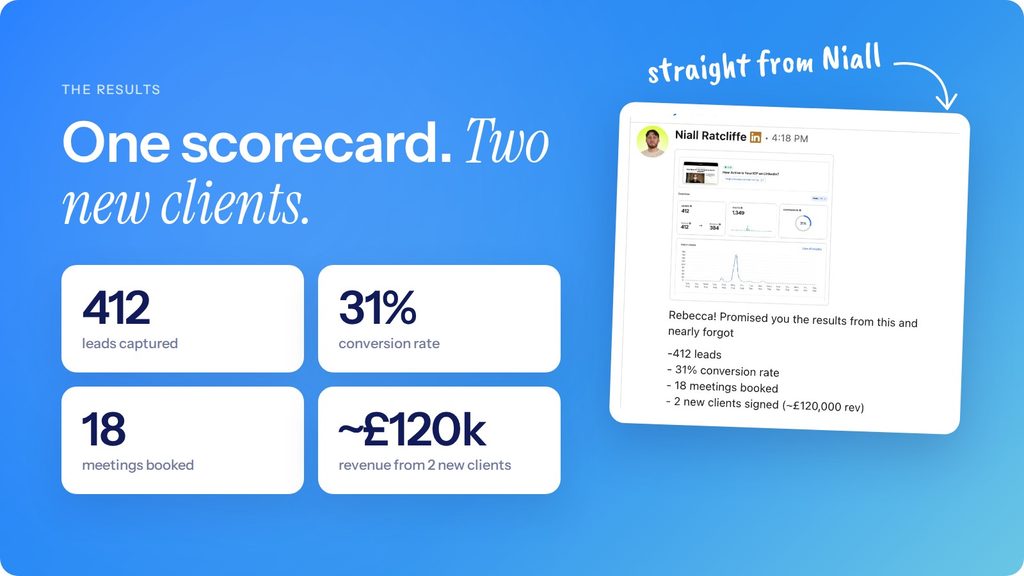
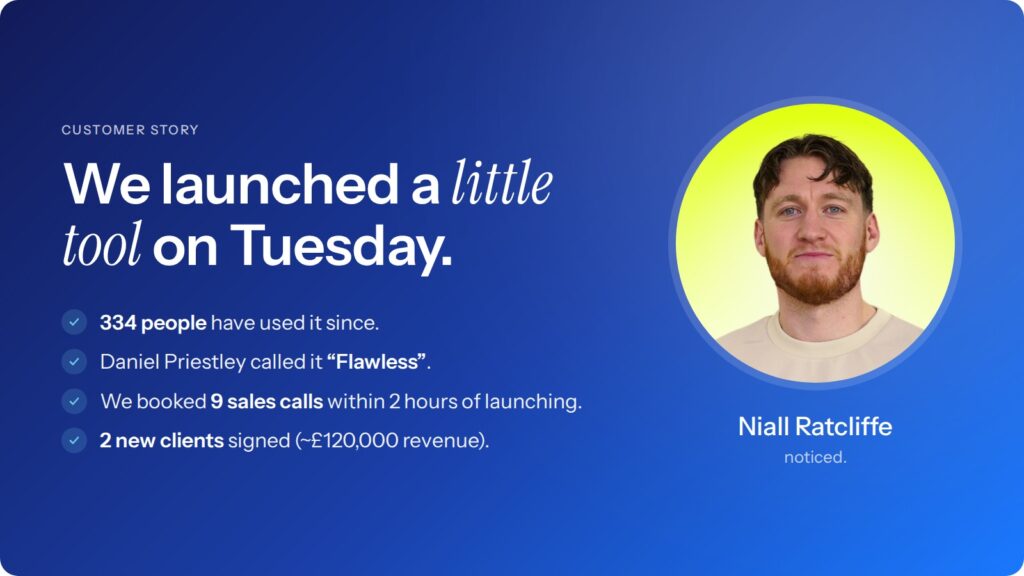
Noticed launched the assessment on a Tuesday. Here’s how it played out:
- 9 sales calls booked within 2 hours of launching
- 334 people used it in the first few days
- 1,349 visits and 412 leads overall – a 31% conversion rate from visitor to lead
- 18 meetings booked
- 2 new clients signed, worth around £120,000 in revenue
Daniel Priestley – our co-founder, who’s seen a few thousand assessments in his time – called it “Flawless.”
That’s the part worth pausing on. This wasn’t a viral moment that produced a big, noisy email list. It produced booked meetings and signed clients. Leads that actually led somewhere.
Why it worked: Niall’s 3 reasons
1. It was stupidly simple
“The tool did one thing: show you how many prospects are on LinkedIn.” No sprawling report, no endless question list. Simple tools get finished, shared, and remembered – which is why the ones that worked for Noticed “were always the simplest ideas.”
2. They built it off objections
“The no.1 objection we get is ‘My ICP aren’t on LinkedIn’. So we built the tool to combat that.”
This is the clever bit. Anyone who hears that objection in their own head is exactly the kind of person Noticed wants to talk to. So the assessment didn’t just attract leads – it attracted the right leads. Niall calls them “pre-validated”: people who were always going to be curious the moment it launched. It’s one of the simplest ways to pre-qualify leads before a sales call.
3. They launched it to an audience they’d spent 3 years building
“We spent the last 3 years purposefully building an audience on the platform our ICP uses most.” When the assessment went live, 100,000 people who already trusted Noticed were there to see it. No ad budget needed to get the first 9 calls on the calendar.
His advice for everyone else? “If you’re not doing this, you should start.”
How to borrow the playbook
You don’t need 100,000 followers to use the thinking behind this. Here’s how to apply it to your own business (and if you want a deeper walkthrough, try our 5-step framework for lead magnets that convert):
- List your top 3 sales objections. The ones you hear on almost every call. Ask your sales team if you’re not sure – they’ll know instantly.
- Turn one into a question your buyer can answer about themselves. “My ICP aren’t on LinkedIn” became “How active is your ICP on LinkedIn?” “We’re not ready for an agency” could become “How ready is your business to scale its marketing?”
- Keep it to one job. Resist the urge to diagnose everything. One clear answer beats ten vague ones.
- Launch it where your ICP already spends time. Your audience, your email list, your partners’ communities – wherever trust already exists. More ideas in our B2B lead generation strategy examples.
- Let the results start the conversation. Every lead arrives with data on who they are and how they scored, so your sales call starts with insight, not a pitch.
Do that well and the objection stops being something you fight on calls. It becomes the reason people book them.
Build your own objection-busting assessment
Noticed didn’t need a bigger lead magnet. They needed a sharper one – one that qualified buyers, revealed who was ready, and personalized the next step automatically. That’s what lead qualification software like ours is built for.
We won’t promise you £120k in a weekend – but if you put in the thinking Noticed did, you’ll have one of the most powerful lead magnets you’ve ever launched.
Who Noticed are
Noticed is a UK LinkedIn B2B outbound agency, co-founded by brothers Niall and Morgan Ratcliffe. They help B2B companies win clients on LinkedIn – and they practice what they preach, having spent the last 3 years building an audience of 100,000 people on the platform.
They’re also no strangers to launches. Over those 3 years, they’ve run hundreds of campaigns – including a 7ft report, a printed book, and fake paper wallets. As Niall puts it: “Many failed, but the ones that worked were always the simplest ideas.”
Want to see the original? Try Noticed’s assessment.