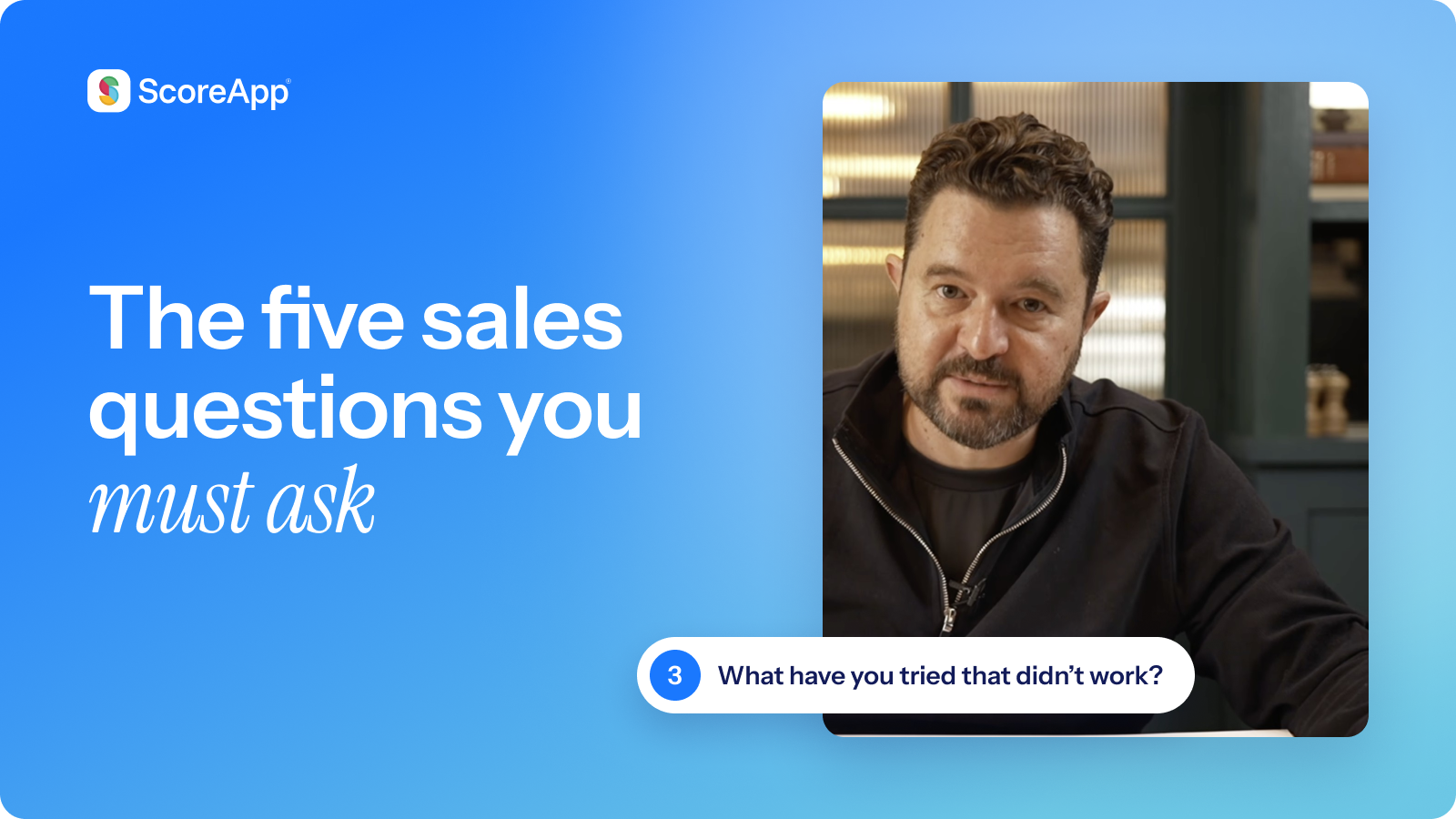

Every business moves through the same five stages of business growth: validation, product market fit, go-to-market, scale-up, and exit. Each one comes with a question you can’t afford to get wrong. Can we sell it? What will people pay for? How do we make sales every week? Who should we hire? What’s the business worth to a buyer?
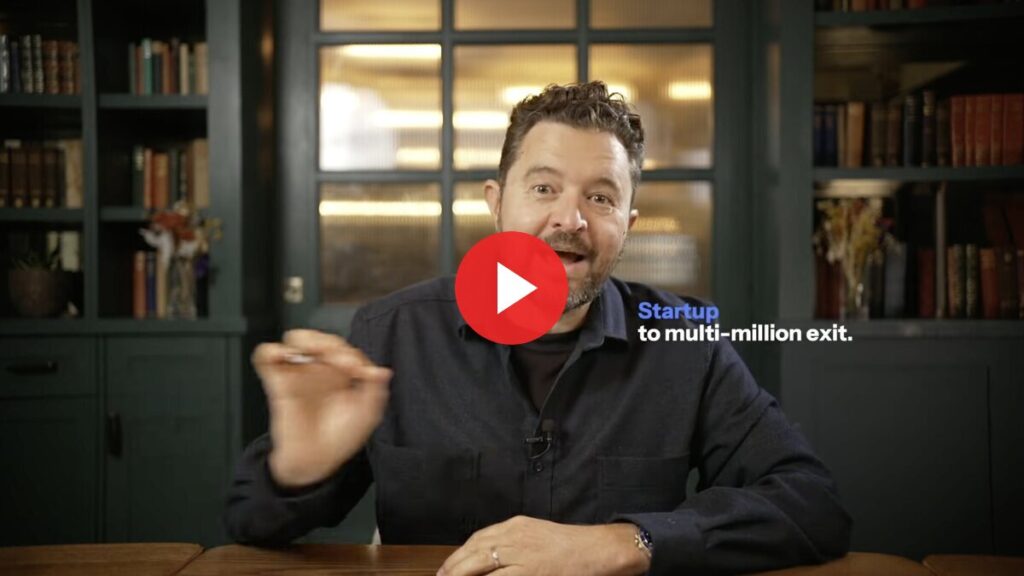
Most founders answer those questions with guesswork. In a five-minute video, our co-founder Daniel Priestley shows how to answer them with data instead – using a scorecard at every stage, “from a startup with no revenue through to a multi-million dollar exit.”
The five stages at a glance
| Stage | The question | What to build |
|---|---|---|
| 1. Product market validation | Can we build it? Can we sell it? | A waitlist with 5–10 questions |
| 2. Product market fit | What do customers want, and what will they pay for? | An assessment with 20–30 questions |
| 3. Go-to-market | How do we make consistent sales every week? | Webinar and mini course registration |
| 4. Scale up | Who can take us into new markets? | A hiring scorecard |
| 5. Exit | What is the future of this business worth? | Customer and market surveys |
Stage 1 – Product market validation: launch a waitlist
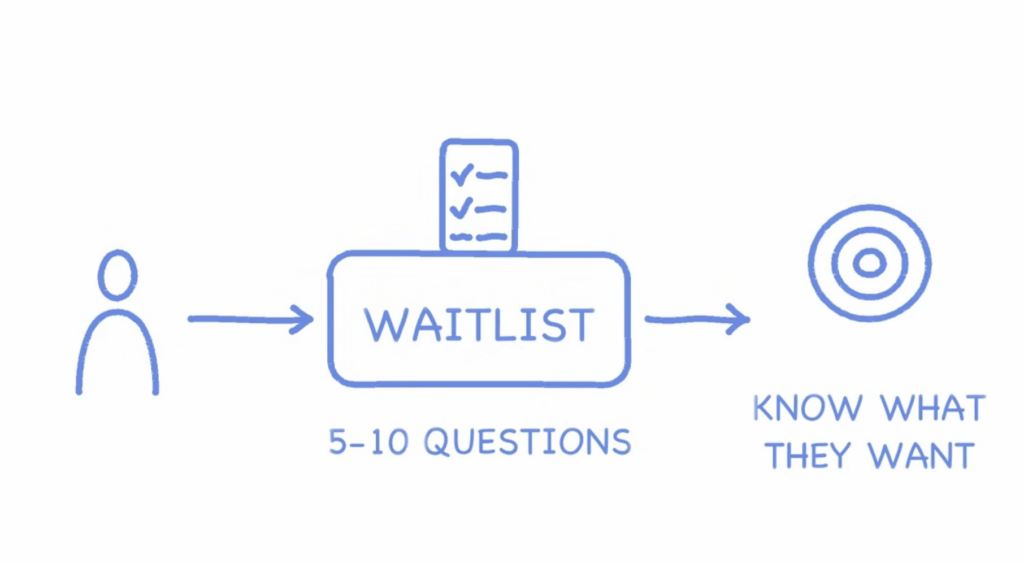
At this stage you’re trying to answer two questions: can we build it, and can we sell it? To do that, Daniel says, “you really need to understand what’s going on in your potential customer’s head.”
The fastest way in is a waitlist. People signal that they want to do business with you once you launch – but instead of only leaving a name and email, they answer five to 10 questions about what they expect from your product or service. Daniel calls it “one of the most powerful ways to take all the fear and mystery out of a product launch.” You find out what people want, and whether they’ll pay for it, before you’ve built the whole thing.
Stage 2 – Product market fit: run an assessment
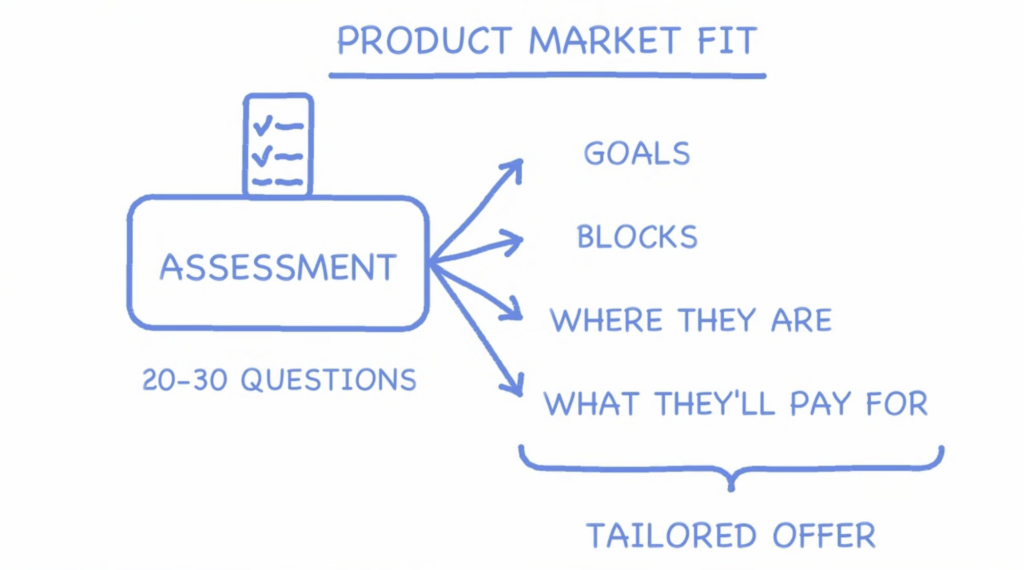
Product market fit is when customers love what you’ve got and don’t want to live without it. You’ve found an ideal customer persona and an offer they’re happy to buy, and you’ve connected the two.
To get there faster, Daniel recommends an interactive assessment – “really an excuse to ask 20 to 30 questions” of your customers. Their answers show you:
- What they’re trying to achieve
- Their biggest blocks and barriers
- Where they are today
- The path of least resistance they’re willing to pay for
With that data, you can tailor your offer to the things that matter most to your customer. Daniel calls it “the perfect fine-tuning tool” for going “from having a lukewarm offer to a red-hot offer.”
Stage 3 – Go-to-market: educate at scale
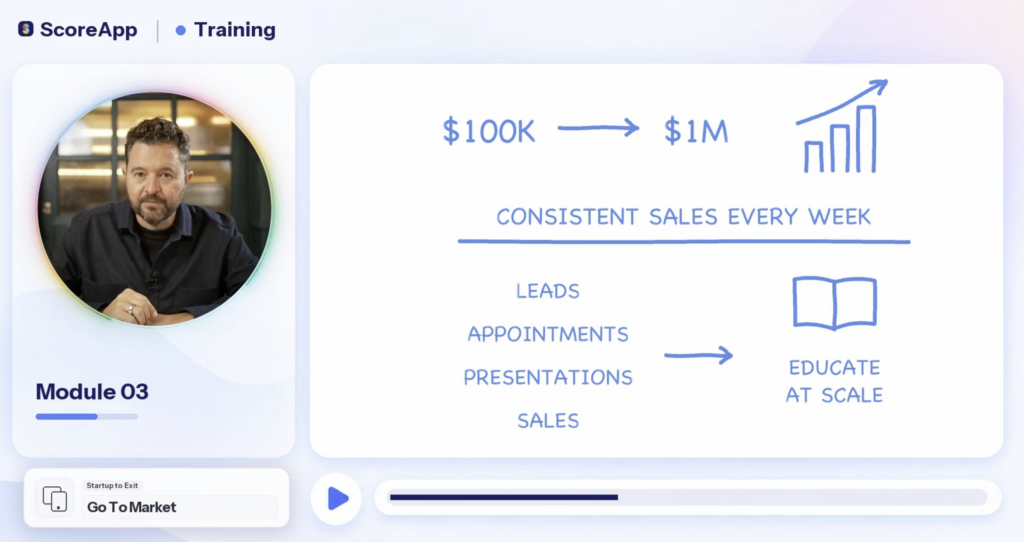
Go-to-market is where you “crank the handle and you make sales.” It’s typically the stage where revenue grows from around $100K a year to $1M.
The key, Daniel says, “is making consistent sales every single week.” That means a steady pipeline of leads, appointments, presentations, and sales – and the thing that speeds it up most is educating your customers at scale through webinars and courses.
The setup is simple: social content and ads send people to a mini course or webinar registration page. Because you’ve already hit product market fit, you know exactly which hot buttons to push. Add a few questions to the registration, and you’ll also know who’s ready to buy before the session starts.
Stage 4 – Scale up: hire with a scorecard
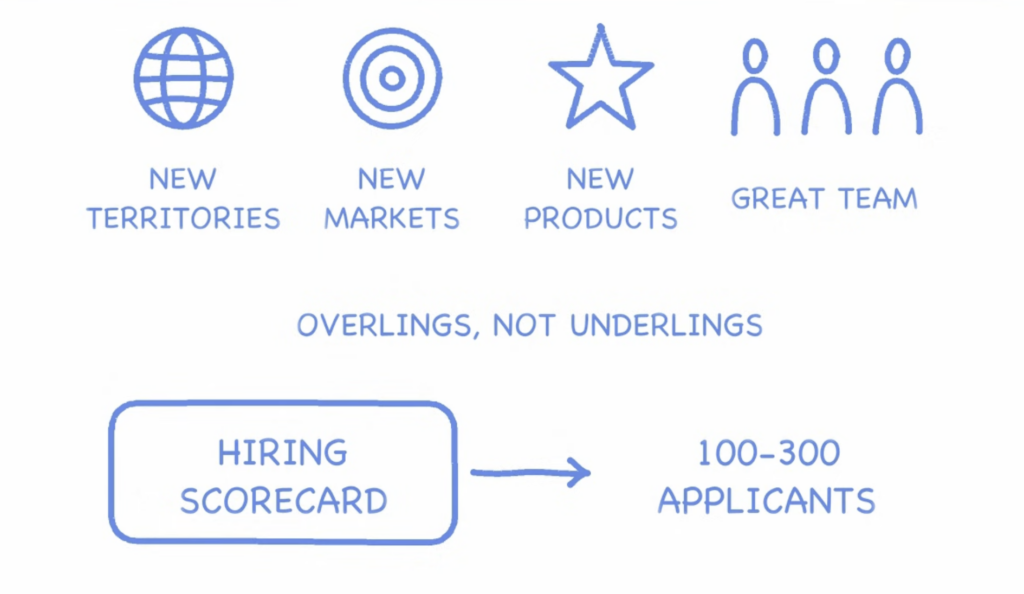
Once you’re past $1M, scaling up means new territories, new markets, and new products. That takes a great team – and a different kind of hire. “You need some overlings, not underlings,” Daniel says: people who’ve done it all before. Until now you’ve probably built your team with “rebels and misfits and contractors.” Now you need serious talent.
A hiring scorecard lets you promote the role far and wide and get 100, 200, or 300 people to apply. The data shows who fits from two perspectives – attitude and skills. When you find someone with both, that’s the talent you’re looking for.
Stage 5 – Exit: sell the future with survey data
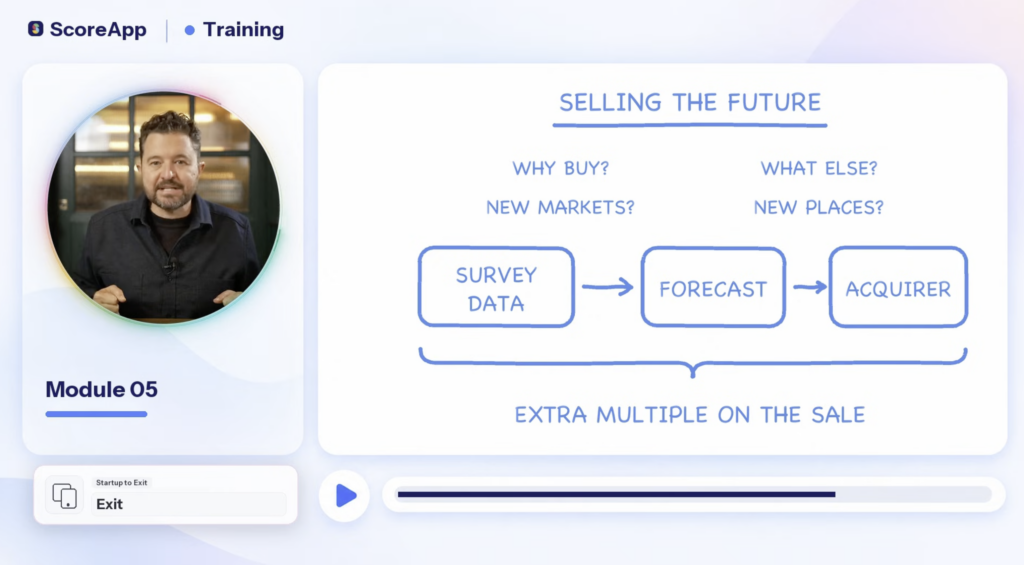
“Exit is about selling the future of the business.” An acquirer wants to know what happens next: is there a strategic reason to buy, what else might your customers buy, and which markets and territories could you expand into?
The best way to show them is survey data. Survey your existing customers about what else they’d want, and survey potential customers in new territories and new markets. Then bring that back into a forward-looking forecast for a strategic acquirer. In Daniel’s words, “that’s the data that will add an extra multiple to the sale value.”
Why a scorecard works at every stage
The five scorecards look different, but they do the same job: they replace a guess with an answer from the people who matter. Waitlist sign-ups tell you what to build. Customers tell you what to charge. Registrants tell you who’s ready. Applicants tell you who fits. Customers and new markets show a buyer what the business could become.
Every one of those answers is zero-party data – given to you directly and on purpose. That’s why you can act on it with confidence, and why it holds up when you put it in front of an acquirer.
How to pick your next scorecard
You don’t need all five at once. Start with the stage you’re in now:
- Pre-launch or testing an idea? Build a waitlist.
- Launched, but the offer isn’t landing? Run an assessment.
- The offer works, but sales are lumpy? Add questions to your webinar or mini course registration.
- Past $1M and hiring for growth? Use a hiring scorecard.
- Thinking about a sale in the next few years? Start surveying customers and new markets now.
Daniel’s advice is to look at “which ScoreApp scorecard would move the needle the most on your business.” Everything in the video is covered by a template or our AI tools, so you’re not starting from a blank page.
New to building one? Daniel’s free 20-minute masterclass, the $1M lead gen system blueprint, walks through how to set up an online scorecard step by step – the same approach he says gets “really high opt-in rates.”
Find the scorecard for your stage
Whichever stage you’re at, there’s a scorecard that gets you to the next one – and the answers your customers give will tell you what to do when you get there.