
Some of the best-known names in business – Ray Dalio, Marie Forleo, Daniel Priestley, and nine others – have built their brands around a quiz funnel. Instead of offering a free ebook and hoping for the best, they ask a few smart questions, give each person a personalized result, and use that result to point them to the right next step.
The person feels understood. The business gets a warm lead, plus the data to see who’s a fit, who’s ready to buy, and what to offer them.
None of them rely on a quiz alone. They have books, podcasts, and big audiences too. But in every case, the quiz or assessment is what turns attention into a qualified lead. Below, we break down how each one works and what you can borrow for your own business, plus a bonus: how Alex Hormozi would turn a $51M funnel into a quiz.
At a glance: 12 famous quiz funnels
| Entrepreneur | Quiz or assessment | Type | What it leads to |
|---|---|---|---|
| Daniel Priestley | Key Person of Influence Scorecard | Scorecard | KPI accelerator program |
| Ryan Levesque | Ask Method quizzes | Segmentation quiz | A different offer for each “bucket” |
| Ali Abdaal | Creator content-value scorecard | Scorecard | Course waiting list |
| Gretchen Rubin | The Four Tendencies quiz | Personality quiz | Books, podcast, and courses |
| Gary Chapman | The 5 Love Languages quiz | Personality quiz | Books and resources |
| Sally Hogshead | Fascination Advantage assessment | Personality quiz | Paid reports, keynotes, and certification |
| Patrick Lencioni | Working Genius assessment | Personality quiz | Team reports and certification |
| Michael Hyatt | LifeScore Assessment | Scorecard | Full Focus planners and programs |
| Brendon Burchard | High Performance Indicator | Scorecard | GrowthDay app and programs |
| Gino Wickman | EOS Organizational Checkup | Scorecard | EOS Implementers |
| Ray Dalio | PrinciplesYou | Personality quiz | Saved profiles, comparisons, and a team version |
| Marie Forleo | Time Stress Quiz | Scorecard | Time Genius program launch |
1. Daniel Priestley: the Key Person of Influence Scorecard
Daniel Priestley is the bestselling author of Key Person of Influence, Oversubscribed, and Scorecard Marketing. He’s also the co-founder of ScoreApp, so yes, we’re a little biased. His Key Person of Influence Scorecard rates entrepreneurs on the five areas of his KPI method: Pitch, Publish, Product, Profile, and Partnerships.
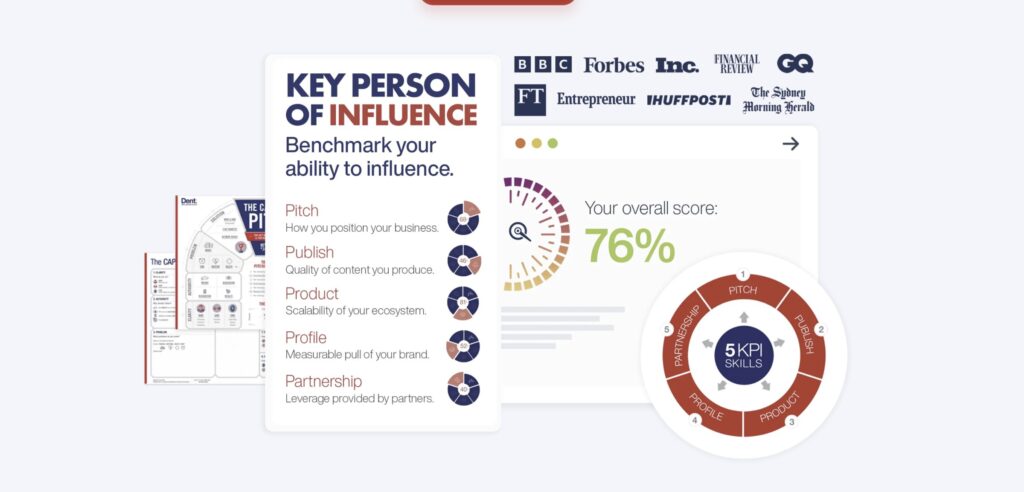
What the result leads to: Each person gets an overall score, a breakdown of strengths and gaps, and a clear next step. People with big gaps know exactly what to work on first. People who score well are ready for the KPI accelerator. The questions do the qualifying, so sales conversations start warm.
What to borrow: Score people against your own framework. A scorecard teaches your method while showing people the gap your offer fills. Priestley lays out the full approach in Scorecard Marketing.
2. Ryan Levesque: the Ask Method
Ryan Levesque wrote Ask, the book that made quiz funnels popular with online businesses. His Ask Method uses a short quiz to sort people into “buckets” based on their situation and goals. Each bucket then gets its own message and offer.
What the result leads to: Instead of one generic sales page, each bucket is sent to the offer that fits its situation. Levesque’s argument is simple: people will tell you what they want to buy if you ask the right questions. The quiz does your market research and segmentation at the same time.
What to borrow: Don’t send everyone to the same offer. Even three result types, each with its own follow-up emails, will usually beat one generic sequence. See our guide to quiz email sequences.
3. Ali Abdaal: a scorecard that fills a course waiting list
Ali Abdaal is one of YouTube’s biggest productivity creators. He used a ScoreApp scorecard to help creators work out the value of their content. Each person gets a score, practical insights, and next steps.
What the result leads to: The scorecard feeds the waiting list for his paid course. By launch day, he knows who signed up, where each person is starting from, and who is most ready to buy.
What to borrow: Run a quiz before a launch. It gives people something useful now and tells you who is most likely to buy later. Read the full Ali Abdaal breakdown.
4. Gretchen Rubin: the Four Tendencies quiz
Gretchen Rubin is the author of The Happiness Project and host of the Happier podcast. Her Four Tendencies framework sorts people by how they respond to expectations: Upholder, Questioner, Obliger, or Rebel.
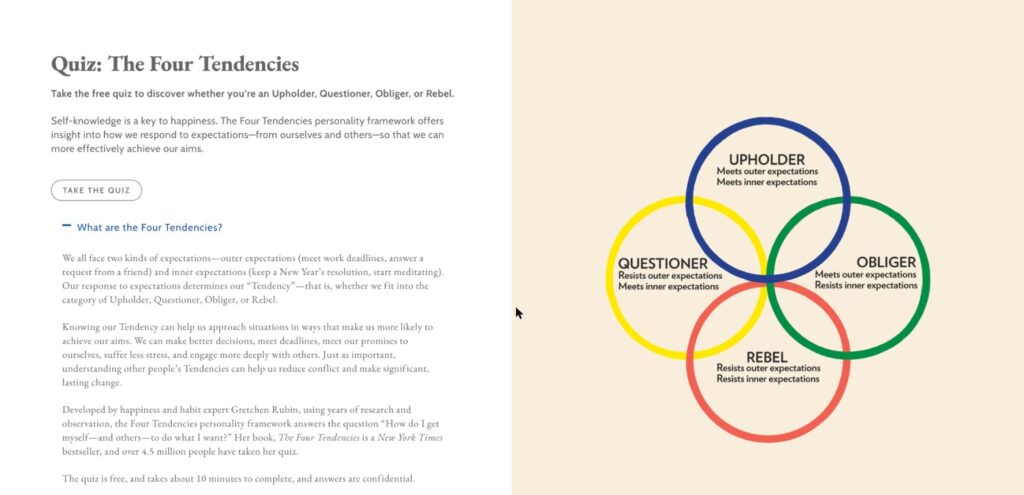
What the result leads to: The free online quiz is the way into her 2017 book The Four Tendencies, plus her podcast, courses, and community. It spreads because the result becomes part of how people describe themselves. “I’m an Obliger” is something people say to friends and colleagues, which keeps the quiz moving by word of mouth.
What to borrow: Give your results memorable names. A label people want to repeat is free marketing. Get ideas from our 30 personality quiz question ideas.
5. Gary Chapman: the 5 Love Languages quiz
Gary Chapman published The 5 Love Languages in 1992, and the online quiz has become one of the best-known personality tests in the world. It sorts people into Words of Affirmation, Quality Time, Receiving Gifts, Acts of Service, or Physical Touch.

What the result leads to: Each result points to books, couples resources, and versions for families and workplaces. The terms are now everyday language, so every person who shares their result is advertising the book for free.
What to borrow: A quiz can keep a book or idea selling for decades. If you have a framework, turning it into a quiz gives every reader and fan a way to try it for themselves and share it.
6. Sally Hogshead: the Fascination Advantage assessment
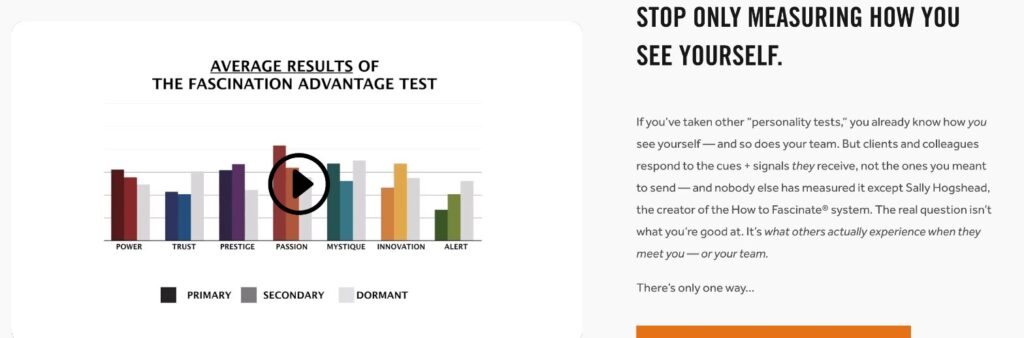
Sally Hogshead, author of How to Fascinate, built her business around the Fascination Advantage assessment. Most personality tests measure how you see yourself. This one measures how other people see you, combining seven “advantages” into 49 archetypes.
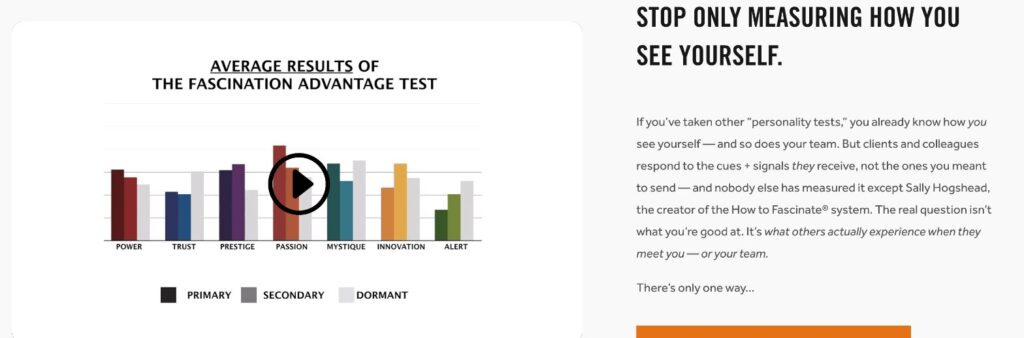
What the result leads to: A short free version introduces the idea. Paid reports, team workshops, keynotes, and a certification program sit behind it.
What to borrow: Make the free result useful on its own, then offer a deeper paid report or a team version for people who want more.
7. Patrick Lencioni: the Working Genius assessment
Patrick Lencioni, author of The Five Dysfunctions of a Team, created the Six Types of Working Genius: Wonder, Invention, Discernment, Galvanizing, Enablement, and Tenacity. The assessment is the center of the whole model.
What the result leads to: One person takes it, then wants their team to take it too. A book, podcast, team tools, and a certification for consultants and coaches are all built around the result.
What to borrow: Quiz funnels work in B2B. An assessment that helps a team work better can sell to the individual, the manager, and the whole organization. See how to boost B2B lead generation with a quiz.
8. Michael Hyatt: the LifeScore Assessment
Michael Hyatt is a New York Times bestselling author and the founder of Full Focus, the company behind the Full Focus Planner. His LifeScore Assessment scores how people are doing across the main areas of life, from health and relationships to work and money.
What the result leads to: A low score in one area shows people exactly where their life feels off. Full Focus planners, coaching, and programs are built to close those gaps, so the offer feels like the obvious next step.
What to borrow: Score several areas, not just one number. A breakdown shows people where to start and makes your offer feel specific to them.
9. Brendon Burchard: the High Performance Indicator
Brendon Burchard, author of High Performance Habits, offers a free High Performance Indicator. It’s a short assessment that scores you on the habits from his book.
What the result leads to: Your score shows how you compare with the habits of high performers. It leads into his GrowthDay app, coaching, and programs.
What to borrow: Base your questions on the core ideas of your book or method, so taking the quiz is a taste of your teaching.
10. Gino Wickman: the EOS Organizational Checkup
Gino Wickman, author of Traction, created the Entrepreneurial Operating System (EOS). His Organizational Checkup asks business leaders to rate their company against a set of statements, giving a total score out of 100.
What the result leads to: Low scores show exactly where the business needs work, which is what certified EOS Implementers help with. The checkup feeds a whole network of consultants, not just one person.
What to borrow: A scorecard can generate leads for a team, a franchise, or a partner network. Everyone uses the same assessment, and every lead arrives with context.
11. Ray Dalio: PrinciplesYou
Ray Dalio founded Bridgewater Associates and wrote the bestseller Principles. In 2021 he launched PrinciplesYou, a free personality assessment co-created with organizational psychologist Adam Grant and psychologists Brian Little and John Golden. It measures 17 dimensions of personality and matches people to archetypes such as Adventurer, Inventor, and Growth-Seeker.
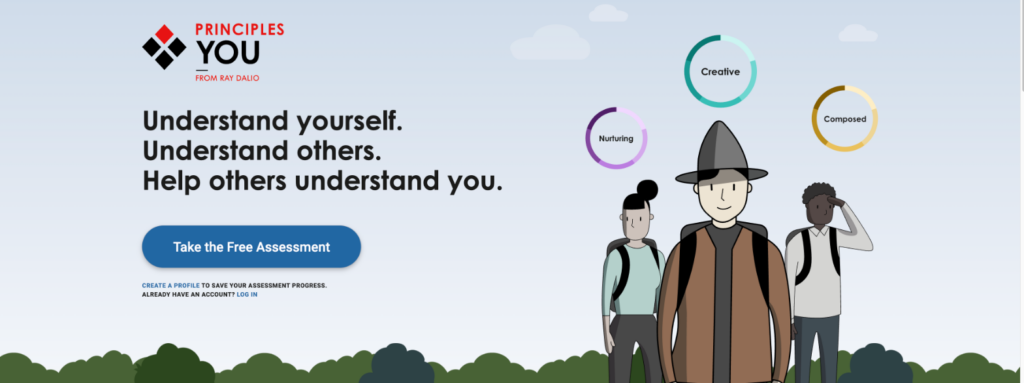
What the result leads to: People create a profile to save their results, then compare them with friends, family, and colleagues. For businesses, the same assessment becomes PrinciplesUs, a team version for improving how people work together.
What to borrow: Make your results social. When people can compare their result with a partner or colleague, everyone who takes your quiz has a reason to invite someone else.
12. Marie Forleo: the Time Stress Quiz
Marie Forleo is the bestselling author of Everything Is Figureoutable and the creator of B-School. She turned her own “Simplify to Amplify” framework into a free Time Stress Quiz, which helps people see what time stress is costing them and what to focus on or drop.
What the result leads to: She promoted the quiz on MarieTV and her podcast ahead of the January 2023 launch of her Time Genius program. Viewers were pointed to the free assessment first, then to Time Genius if they wanted to go deeper. By the time the program opened, she had a warm audience that had already named its problem.
What to borrow: Use a quiz to open a launch. Promote it before your doors open, so you go into launch week knowing who’s interested and what they’re struggling with.
Bonus: how Alex Hormozi would turn a $51M funnel into a quiz
Alex Hormozi, founder of Acquisition.com and author of $100M Offers, doesn’t use a quiz as his main lead source. But when the founder of a $51M-a-year genetic report and supplement business asked him how to sell to confused customers, his answer was immediate: “This is a quiz funnel.”
The founder’s problem is one many experts will recognize. His customers arrived with very different issues, from infertility and pregnancy to anxiety and ADHD, and he didn’t want anyone buying the wrong product. Hormozi’s fix:
- Ask quiz-based questions that sort people by their issue.
- Branch each answer to one of about 10 videos, one for each of the most common problems.
- Recommend the right product at the end of each path.
- Drive traffic with partners. Recruit influencers and give them all the profit on a low-cost front-end offer.
- Make the money in follow-up. Use segmented email sequences, based on each person’s answers, to sell the right products afterward.
What to borrow: If customers don’t know which of your offers they need, don’t make them guess. Let the quiz diagnose the problem, then recommend the right fit. Watch the full breakdown on YouTube.
What these quiz funnels have in common
- They’re built on a framework. Every quiz above turns the creator’s own model into questions. The quiz teaches the method while it qualifies the lead.
- The result feels personal. People get a score or type that describes them, not a generic PDF.
- The results are worth sharing. Named types and scores get talked about, which brings in more people.
- Each result has a next step. Low scorers, high scorers, and different personality types each see the offer that fits them.
- They show who’s ready, not just who’s interested. By the time someone books a call, you already know their situation, their gaps, and how ready they are to buy.
- They keep working for years. Several of these frameworks are more than a decade old and still bring in new leads every day. A good quiz is built once and promoted for years.
Personality quiz or scorecard: which should you build?
Personality quizzes (Rubin, Chapman, Hogshead, Lencioni, Dalio) work best for wide reach and sharing. They suit consumer audiences, authors, and creators.
Scorecards (Priestley, Abdaal, Hyatt, Burchard, Wickman, Forleo) work best when you sell a high-value product or service. A score shows people the gap between where they are and where they want to be, and your offer closes that gap. They suit coaches, consultants, and B2B businesses.
Many businesses use both. If you’re not sure, start with a scorecard. It’s easier to link to a paid offer, and it qualifies leads from day one.
How to build your own quiz funnel
- Pick your framework. List the 3–5 areas that decide whether your clients succeed.
- Write 10–15 questions. Most should be scored against your framework. Add two or three that reveal readiness, such as budget, timeline, or what they’ve already tried. See our 84 quiz question examples.
- Create useful results. Give people their score or type, what it means, and one clear next step. Here’s what to include on your quiz results page.
- Match an offer to each result. Book a call, join a waiting list, buy a book, or start a course. The people most ready to buy should get the most direct route to you.
- Send people to it. Add it to your website, bio links, podcast, emails, and talks.
You can start from one of our ready-made templates, or let our AI builder write a first draft for you to refine.
Ready to build yours? Browse ScoreApp templates and create your quiz funnel today.
Frequently asked questions
Well-known examples include Daniel Priestley, Ryan Levesque, Ali Abdaal, Gretchen Rubin, Gary Chapman, Sally Hogshead, Patrick Lencioni, Michael Hyatt, Brendon Burchard, and Gino Wickman. Each uses a quiz or assessment to qualify leads and point people to the right next step.
A quiz funnel uses a short quiz or assessment to capture and qualify leads. People answer questions, share their email to see a personalized result, and are then shown the product, service, or content that best fits their answers.
Yes. Scorecards such as the EOS Organizational Checkup and Working Genius are aimed at business leaders and teams. A scorecard qualifies leads before a sales call and gives your team the context for a better conversation.
A personality quiz sorts people into types, which makes it easy to share and good for building an audience. A scorecard rates people against a set of criteria, which shows them where they need help and leads naturally to a paid offer.
Start with your own framework, write 10–15 questions, create a useful result for each score or type, and link each result to a next step. A quiz builder such as ScoreApp lets you do this without code, using templates or AI.
Ready to build yours? Simple drop your website URL and objective into our AI builder and watch the quiz funnel building commence. You’ll be able to launch your own quiz funnel today.