
What if you knew that for every four sales conversations you had, one would become a client?
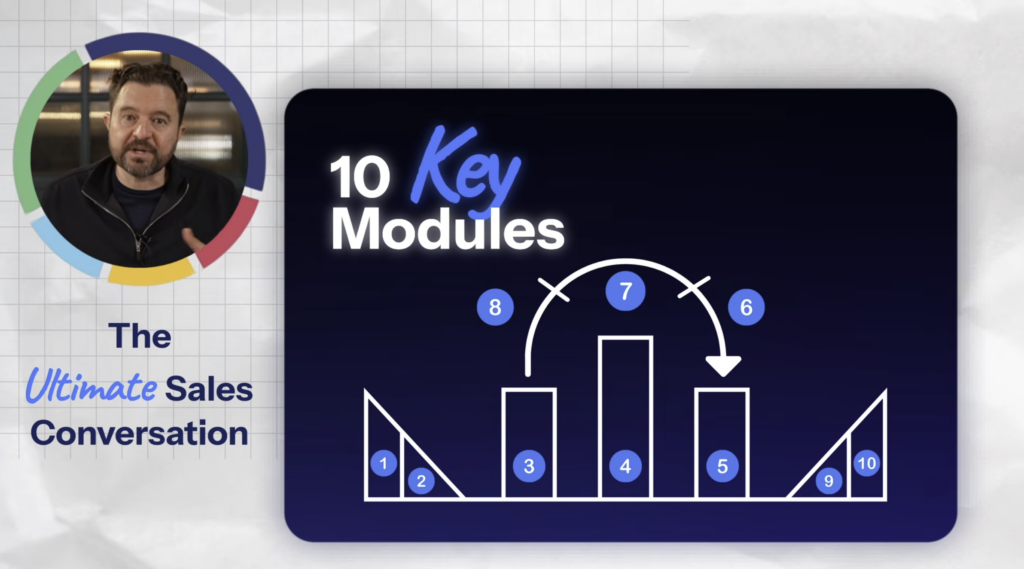
That’s not a hypothetical. It’s Daniel Priestley’s actual close rate – and it has nothing to do with charisma. Over 20 years, he’s refined his sales conversations into 10 modules, run in the same order, every time. Sales stops being improv and becomes a science.
Here’s the full framework.
Part 1: framing and rapport
Think about a surgeon who says “count backwards from 10” with no introduction. Terrifying. Now think about one who says “I’ve done this a thousand times – you’re going to be fine.” Same procedure, completely different feeling.
That’s framing – a 30 to 90 second, well-rehearsed opener that tells people who you are, where your insight comes from, and why they can relax. Your lead isn’t a mind reader. Don’t make them guess your credibility.
Rapport is the other half – warmth, common ground, chemistry. Framing is push energy, rapport is pull. You need both.
Part 2: discovery – the present, the problem, the prize
Discovery is three baskets, and all three need filling:
- The present – where are they now, and how did they get here?
- The prize – if they could wave a magic wand, what’s the outcome they want?
- The problem – what’s actually stopping them getting there?
Most salespeople over-fill one basket and ignore the others. All three, every time.
Part 3: insights, methods, solutions
Here’s the counterintuitive bit: jumping straight to the solution kills the sale. It feels like too much, too fast, too soon – and people dig their heels in.
Instead: share insights (reflect back what you’re seeing – it’s cathartic, and it proves you listened), then your method (the principles you’ve built from seeing hundreds of situations like theirs), and only then the solution – what you’d do together, what it costs, how it works. Presented in that order, the solution lands as the obvious next step rather than a pitch.
Part 4: discuss and complete
Discuss what’s less than perfect – price, plan, adjustments, objections. Then complete: agree exactly what happens next, whether that’s signing up or booking a follow-up after they’ve spoken to a partner.
The part that makes it all work
Daniel’s blunt about this: without data collected upfront, the whole thing gets harder. Framing and rapport with a name-and-email lead is an art form. With a completed assessment, it’s a science – you walk in already knowing their present, their problem, and their prize, with your insights prepared in advance.
That’s what a ScoreApp assessment does. Your lead answers 15–40 questions before the call, you both get the report, and the meeting becomes a conversation about what you already know – not an interrogation.
Ready to make your sales conversations a science?